
Latest Insights
Featured Whitepaper
Optimize Your Suppy Chain To Combat The Margin Crisis

A new survey from Black Book Research gives strong insight into how supply chain tech buyers are thinking. Not surprisingly, it’s with their wallets.
Black Book surveyed 1,604 buyers of health system supply chain technology for its latest report, “State of Healthcare Supply Chain Management Technology Q3 2026.” The results show how important ROI has become to the mindset as health systems adopt and implement AI across the supply chain.
Here are the six trends shaping AI buying trends within health system supply chains, according to Black Book’s survey.
- Margin accountability is replacing isolated savings claims. Buyers are expecting AI solutions to have an effect on working capital. This is in line with what we’ve heard and seen at Clarium. Amid a margin crisis, health systems need ROI from their AI tools and they need it now.
- Clinical value is a supply chain requirement. Clinical supplies are being evaluated alongside utilization, outcomes, recall readiness, substitution risk, traceability and physician acceptance. This is one of the biggest challenges for managing disruptions within the supply chain. There is rarely an easy, one-to-one substitution in healthcare. This isn’t substituting Pepsi for Coke. If an item is not available, clinicians need to be involved in the process of validating and accepting the replacement. This is why we include and empower clinician supply chain leaders in the deployment of Clarium.
- AI is moving from pilots to governed production. The importance of governance was a frequent topic of discussion at last week’s Association for Health Care Resource & Materials Management (AHRMM) conference. To me, it shows the maturation of supply chains in healthcare.
- Cybersecurity and recovery readiness are becoming selection gates. This should come as no surprise to anyone. This year has seen major cyberattacks to two of the industry’s most prominent medtech vendors: Stryker and Intuitive Surgical.
- Data quality and interoperability are operating-cost issues. This is right in Clarium’s wheelhouse. We see it all the time. Historically, supply chain data is a mess. It’s segmented and not uniform. The only way to effectively automate supply chain tasks is to unify and clean the data.
- Contracts are getting tied to outcomes. This trend is happening because many AI vendors promise the world but fail to deliver. Health systems should only use vendors that have delivered for previous customers.
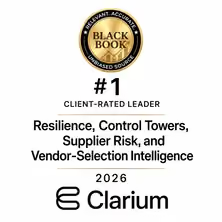
Clarium is ahead on many of these trends. This is why Black Book’s buyers ranked as the #1 supply chain tech vendor in healthcare across 18 qualitative performance indicators, according to our clients. Specifically, we were ranked as the market leader for resilience, control tower, supplier risk and disruption response.
I believe it’s because we understand what supply chain buyers are thinking. It didn’t happen by accident. Our team goes in deep with all of our customers to know how their supply chain operation works and how we can help them.
Thanks to all of our health system partners who ranked us #1. It’s an honor to serve your organizations.

JPM Summit: Supply Chain Is the Low-Hanging Fruit CFOs Are Missing
Clarium CEO and Founder Steve Liou spoke about the importance of supply chain in helping health systems reduce margin pressures at J.P. Morgan's CEO/CFO Health System Summit in New York City this week.
Steve shared his insights on a panel, "Managing the Margin," moderated by Scott Becker, Founder of Becker's Healthcare and Partner at McGuireWoods. The panel, part of the multiday JPM Health System Summit event, looked at whether the playbook for health systems managing margins has changed over the last few years or if they're still leveraging the same playbook.
In making the case to CFOs for focusing on the supply chain, Steve noted that health systems currently have margins in the 1-2% range. They're facing another 600-700 basis points of margin pressure over the next five years, per McKinsey.
"You need to act," Steve said. “Supply chain is the second-largest expense on your P&L.”
Steve estimated that a typical health system spending $400M on medical supplies could optimize around 15% of that spend, yielding roughly $60M in average savings. Some of the biggest savings in the supply chain can come from using AI to optimize inventory management and reduce operating room supply waste, he said.
During the panel discussion, Steve spoke about why it's important for supply chains to normalize, unify and surface their data. This strategy enables leaders to see exactly what they're buying, where it's being used, and what it actually costs.
"One of our health system clients manages over 400,000 product SKUs," Steve noted during the panel. "For perspective, someone like Costco manages 4,000 product SKUs. We're talking about a 100x difference. It's an enormous data challenge that, prior to AI, was impossible to manage."
Other panelists included Sam Perkins, President of Nourish; Dale Yake, CEO of PT Solutions; and Rick Carrico, CFO of Baptist Health in Kentucky.
Corewell’s supply chain strategy centers on AI as it opens a CSC
Corewell Health is overhauling its supply chain operations as the 21-hospital system gets ready to open a highly automated 300,000 square-foot consolidated service center (CSC) later this year. In advance of opening this facility, Corewell recognizes the need to leverage its strategic supplier relationships to maximize the value of the CSC and ensure efficient supply chain operations.
Corewell selected Clarium as an AI-native automation platform to strengthen visibility, responsiveness and resilience across its supply chain operations. Andrea Poulopoulos, Senior Vice President of Supply Chain at Corewell, spoke with Clarium’s Gabriel Perna to understand why the organization is investing heavily in supply chain, why they picked Clarium and how she envisions this partnership taking shape.
Why Supply Chain
Corewell’s investment in a CSC and an AI automation platform comes at a critical time for the organization. The February 2022 merger between Beaumont Health and Spectrum Health to form Corewell allowed the health system to take best practices from both organizations and elevate its supply chain team. At the same time, the health system has realized the impact disruptions have on continuity of care, deriving lessons from COVID-19 and beyond.
A CSC allows Corewell to continue to grow while managing its supply chain operations uniformly and accurately. Leaders at Corewell will be able to deploy supplies more efficiently while preparing for disruptions, such as weather events or product discontinuations.
By leveraging Clarium, Corewell Health can more confidently ensure continuity of care for its patients while reducing costs. Driving incremental cost reduction requires an intricate, complicated and collaborative process across the organization.
“At Corewell, we recognize the essential role supply chain plays—not only in ensuring clinicians have the products they need to care for patients, but also in helping reduce expenses across the organization,” Poulopoulos said.
Why Clarium
For the CSC to work effectively, Corewell needs AI to help leaders plan for disruption events. By embedding AI in the workflow of Corewell’s supply chain, the health system will be better prepared for product shortages and recalls, while making thoughtful substitutions that don’t impact patient care.
Clarium’s focus on developing a tailored product disruption module will significantly enhance workflow management and streamline the decision-making processes. The company’s collaborative approach aligns with Corewell’s goals to achieve supply chain efficiency. Working closely with Corewell’s clinical team, Poulopoulos envisions digesting and acting on insights from Clarium’s AI platform to reduce costs and maintain excellent clinical care during disruption events.
“We’re building a state-of-the-art facility, and that creates an exciting opportunity to align our technology, processes and ways of working to fully support its potential,” Poulopoulos noted.
About Clarium
Clarium is an AI-powered automation platform that transforms the hospital supply chain into a systemwide margin lever. Clarium's agentic AI-native system empowers health systems to enhance patient care and workforce development by reducing operational waste. Our innovative platform automates supply chain processes, turning financial misallocation into meaningful reinvestment and margin expansion.
Continuously learning AI agents convert intelligence into coordinated action across facilities, delivering measurable financial and operational gains in weeks without disrupting care or clinical autonomy.
Founded in 2020, Clarium is trusted by more than 20 health systems representing nearly 30% of U.S. healthcare supply chain spend. The company has raised more than $43 million from leading investors, including General Catalyst, Northzone, AlleyCorp, Kaiser Permanente Ventures, and the TMC Venture Fund.
About Corewell Health™
People are at the heart of everything we do, and the inspiration for our legacy of outstanding outcomes, innovation, strong community partnerships, philanthropy and transparency. Corewell Health is a not-for-profit health system that provides health care and coverage with an exceptional team of 60,000+ dedicated people — including more than 12,000 physicians and advanced practice providers and more than 16,000 nurses providing care and services in 21 hospitals, 300+ outpatient locations and several post-acute facilities — and Priority Health, a provider-sponsored health plan serving more than 1.3 million members. Through experience and collaboration, we are reimagining a better, more equitable model of health and wellness. For more information, visit corewellhealth.org.

AI in Healthcare Supply Chain: Lessons From 100+ Executives
In July 2026, McKinsey released a survey of more than 100 health system supply chain executives in a report titled, “Powering Up Procurement: AI In Healthcare Supply Chains.” The results of the survey confirm what our team at Clarium team has been advocating for since we’ve started.
The takeaway is clear: ROI isn’t a nice to have, it’s a must have. AI platforms and tools must deliver a sizable return on investment in the next three years. Health system supply chain executives have spoken, and they’re ready to get their money’s worth.
Here are some of the key stats from the McKinsey report:
- 65% of respondents expect significant (5-10%) cost savings from AI within the next three years; 26% expect transformational (greater than 10%) savings.
- 46% of those using AI in the supply chain have already doubled their ROI while another 20% have seen smaller gains.
- 75% of respondents say their organizations have a dedicated budget for investing in AI for supply chain.
- Overall, 85% of organizations are pursuing AI adoption in the healthcare supply chain.
Health system leaders ranked the top areas where AI had the greatest potential in the supply chain to generate returns. It’s no surprise that it aligns with the key areas where Clarium has focused its development efforts: supplier performance management and transparency, supply-demand forecasting and predictive analytics, and inventory management.
The McKinsey report had a few more stats that caught my eye:
- 44% say their organizations lacks a clear business case for AI adoption in the supply chain.
- 42% say the most beneficial AI are agents that could proactively anticipate needs and make decisions semi-autonomously, after learning from past behavior. This is in line with what our customers are asking of us. I’d expect that number to be even higher in next year’s report.
- 76% of respondents said data privacy and regulatory compliance has slowed the pace of adoption of AI in the supply chain.
To those of us who have been working on delivering outcomes and cost savings for health systems, this report was incredibly validating.
Here are four pieces of advice to health system leaders that are still figuring this out:
- Demand that vendors show measurable ROI within a predefined window, and walk away from anyone who won't commit to those results.
- Focus on the companies that have built deep, trusted relationships with your peers, and also have real-world case studies to back up their claims. Word of mouth goes a long way in healthcare for a reason.
- Fix your data before you deploy AI. Every health system is under pressure to have an AI strategy, but AI on top of dirty, fragmented data only produces expensive noise faster.
- Elevate supply chain to a strategic function. Amazon and Walmart treat supply chain as a competitive advantage, while some health systems still treat the function as a back office function. CEOs should give their supply chain leader a real seat and voice at the executive table.

AHRMM 26: Data ownership, ROI for resiliency and more
One of the biggest conferences in the healthcare supply chain world is in the books.
Industry trade group Association for Health Care Resource & Materials Management (AHRMM), of the American Hospital Association, held its annual conference this week from July 26-28, 2026 in San Antonio, Texas. The event brought together more than 1,000 health system supply chain professionals as well as vendors, suppliers, distributors and other key stakeholders.
Amid the education sessions, keynote addresses and countless conversations on the exhibit floor, five themes emerged from this year’s show.
Here’s a rundown:
1. Supply chain has gone from the back office to the board agenda.
For a long time, supply chain was relegated to the health system’s proverbial basement and seen as a back office function. No more!
Stephen Downey, Chief Supply Chain and Support Services Officer at Cleveland Clinic, kicked off AHRMM 2026 by declaring that the supply chain in health systems has gone from the back office to being on the board’s agenda.
“We’re not going back,” Downey said.
This is the most consequential generation of supply chain leaders that the profession has ever produced, Downey said, setting the tone for the rest of the show. Every health system needs to empower its supply chain to find savings at a time when health systems are facing unprecedented margin pressures, he said.
2. Clean data is a must have for automation.
As health systems start to deploy agentic AI, they don’t want to accelerate the speed of bad information. In order for automation to work correctly, data needs to be unified and cleaned.
This was a recurring theme heard from several speakers at AHRMM 2026. During various panels throughout the event, supply chain and tech leaders at Cleveland Clinic, Kaiser Permanente, Ochsner Health and St. Luke’s Health all talked about the importance of data integration and integrity.
The data cleaning process can be frustrating as it may mean delaying a go live of a critical system. But this is important as small data irregularities in the ERP and other systems can compound into bigger problems without the right data foundation, said René Gurdián Jr., Vice President of SCM Data Analytics and Transformation at Ochsner Health.
3. Health systems, own your data.
Understanding the importance of data cleaning and unification is part of a larger need for health systems to establish comprehensive data governance protocols. Steven Chyung, Chief Supply Chain Officer at Kaiser Permanente, said his organization is creating governance councils across multiple areas of the health system that are interacting with AI, including clinical, administrative and patient-facing technologies.
Part of data governance is the recognition that the health system itself knows best how to operationalize its own data, rather than vendors, consultants or suppliers.
“We need to be owners of our data,” Gurdián said. “When we talk about this AI world, in order for us to talk about AI, the prerequisite of AI is data governance. We have leaned heavily on the creation and curation of a data governance team that helped us prepare for migration of an ERP conversion.”
4. There is an ROI to resiliency.
With margin pressures on the minds of every health system executive, those championing AI tools in their organization are feeling the pressure to prove the value of those investments.
In the supply chain, panelists at AHRMM said leaders should be ready to speak the language of their audience. In terms of ROI, they should be able to inform others within the organization how the AI tools they use within the supply chain leads to cost savings.
There is an ROI to using AI for supply chain resiliency, said Amanda Chawla, Chief Supply Chain Officer and Post Acute Care Officer at Stanford Health Care (who recently took a job with Providence).
Chawla used the example of a recent fire at one of Stanford’s supplier’s warehouses on how to show the ROI for AI-based resiliency tools. Stanford’s investment into AI for resiliency meant the health system was able to fill critical orders from other warehouses and not have patient care disrupted at all, she said.
5. Supply chain leaders must speak multiple languages.
As the supply chain grows in prominence, leaders can’t stick to their supply chain silos. The supply chain isn’t just a single job, it’s a portfolio of specializations, said Downey.
Supply chain leaders must speak three languages to run an effective operation, Gurdián said. They have to speak financial and income statements; supply chain category and contracts; and clinical utilization and consumptions.
“You need to be amazing at all three languages,” Gurdián said. “You’re amazing at a million things, so what’s three more languages?”
Bonus: The conference highlighted the excitement happening in hospital supply chains. There is a record number of emerging technologies in the sector. Companies focused on clean data and AI-enabled insights layered on top of existing workflows are the ones that seem to be standing out.

Health system CFOs to supply chain: 'Show me the money'
Clarium Strategic Advisor, Eric O'Daffer, recently posted a blog, "Healthcare CFO: Show me the Money!”, about the value that supply chain can bring for health system chief financial officers looking for cost savings. At a time when supply chain executives at health systems are facing unprecedented headwinds, O’Daffer argues that CFOs would be wise to empower these leaders and invest in AI to manage spend.
Here’s an excerpt:
As implied in the classic demand “Show me the money!” in the film Jerry Maguire, there is a massive financial opportunity to demonstrate value waiting inside your organization. I encourage you — the health system CFO — to engage with your supply chain leadership team in a deeper strategic alliance to drive these results. Your team possesses the technical know-how to deliver savings, but they need your passionate leadership, backing, and a willingness to give them the strategic support required to get the job done.
Being a CFO of a health system is an incredibly demanding job. Balancing shifting reimbursement models, uncompensated care, and the iary pressures of keeping a low-margin, vital caregiving engine humming is a monumental task. Currently, nearly 60% of CFOs have supply chain reporting directly to them, which gives their supply chain teams a unique opportunity to align with the CFO’s vision now more than ever. However, it is vital to look closely at a recent trend: health systems are reducing supply chain title, scope, and compensation while making leadership transitions without a seamless succession plan. My insights here are intended to provide a candid look at the market gained from talking with 75 chief supply chain officers (CSCOs) at large, leading health systems over the past 12 months. I come with collaborative solutions, not just an analysis of the challenges.
Supply chain leadership is facing unprecedented headwinds at a growing number of health systems in the U.S. With roles being restructured, positions being shifted down the org chart, and capital investments being paused, many health systems are inadvertently losing momentum at the exact moment they should be accelerating supply chain support to drive financial returns. This is especially true in the area of indirect spend management/purchased services where trusted relationships, governance, and continuity are most important for enacting change and delivering value.
Chief supply chain officer roles that once reported to the C-suite are being shifted to VP roles reporting downline. This can inadvertently result in a fractured hiring strategy, gaps in development, and a lack of long-term succession planning. Furthermore, there is a wide disparity in compensation across the country, with some systems investing over a million dollars for top-tier enterprise roles while others budget a quarter of that for similar responsibilities.
Over 40% of the 75 leaders of large, mature healthcare provider supply chains I’ve talked to in the past year have been in their roles for less than three years; nearly 25% have been there for less than one year. It is incredibly difficult to reach that stable cruising altitude when health systems are forced to frequently change pilots.
When organizations downsize supply chain leadership roles, it suggests the supply chain is still being viewed through the legacy lens as a "product availability" or “contract price negotiation” function, rather than as a powerful strategic lever for cost optimization and enabling improved clinical care.
Fortunately, this isn't happening everywhere. I see highly encouraging progress in specific pockets, but this concerning trend is creating a widening chasm between the systems that proactively invest in supply chain excellence and those that defer it.
AI can provide value
CFOs, you need to commit to the strategic function that impacts 40% of your operating cost. Move beyond the traditional "VP of procurement" mindset and elevate or maintain a dedicated CSCO role. According to the Health Management Academy, supply chain is currently ranked 10th out of 15 categories for CFO investment priorities in 2026. Elevating its priority on your list allows you to invest in the specialized talent and technology required to drive transformational service improvements.
When it comes to AI, healthcare supply chain has historically taken a cautious, "prove it to me" approach to new technology. However, while healthcare waits, a massive wave of innovation and investment is flowing into AI-driven supply chain solutions in other sectors.
For CFOs and supply chain leaders, I encourage you to get off the sidelines and actively explore how partnering with AI platform innovators can support your fiscal goals both in managing supplier spend and in reducing your total cost of supply chain staff by augmenting with AI workforce solutions.
This text has been condensed and repurposed for Clarium by Gabe Perna.
For health systems, a dollar cut is much more than a dollar earned
Health systems facing tight margins have to move beyond revenue generation strategies and look towards cost cutting.
This was one of the major themes of a recent wide-ranging conversation between Clarium CEO Steve Liou, former Jefferson Health CEO and executive-in-residence at General Catalyst Dr. Stephen Klasko and Becker’s Healthcare founder and publisher Scott Becker on Becker’s Healthcare Podcast.
Supply chain is an ideal area for cost cutting and will allow health systems to reinvest in patient care.
“Health systems have really focused on how to increase revenue, which is why revenue cycle and prior authorization automation has received tremendous investment in the last several years,” Liou said during the podcast, which went live on May 6. “We think that a lot of that juice has been squeezed and we think that they need to reframe their thinking into how we can cut dramatic costs out of our health system and help really dramatically expand margins.”
Here were five key points addressed in the podcast.
- A dollar cut vs. a dollar added. Health systems need to rethink their strategies in terms of margin expansion. Cutting a million dollars in cost is around the same equivalence economically as generating $100 million in revenues, Becker said on the podcast.
- This has an outsize impact on rural health and health equity. Rural and safety-net hospitals pay more for certain supplies, such as hip implants, because they don’t have the same purchasing power or intelligence as an academic health system. Every dollar spent unnecessarily on the supply chain is a dollar that doesn't reach a patient who needs insulin or another important treatment, Dr. Klasko said.
- Hospitals are still dealing with COVID-19-era margin challenges. Klasko said that hospitals are running on a pre-COVID mentality in a post-COVID era. The labor crisis didn't end. The supply crisis didn't end. The margin crisis didn't end. We just stopped looking at them as a crisis,” Klasko said. “You can't run a 2026 health system on a 2019 procurement infrastructure and pretend it'll hold.
- Supply chain waste in the U.S. healthcare system is enormous. Citing data from Navigant, Liou estimates there is between 40 and $45 billion per year in unnecessary spend on supply chain and operations. Hospitals could potentially double their margins if they optimized clinical and supply chain margins.
- Supply chain can’t be relegated. Supply chain executives need to be part of the health system strategic conversations. CEOs, chief financial officers and chief operating officers need to pay attention to how their supply chain operates, Liou said. “Stop viewing supply chain as a back-office function,” he said. “Bring your chief supply chain officer into the C-suite, into the boardroom. Give them a seat at the table. Learn how you can further support them really to unlock a transformational change.”

Health systems, what are the AI cybersecurity risks in your supply chain?
Nothing is safe from cybercriminals these days, certainly not health systems.
A cybersecurity-related shutdown was the centerpiece of a seasonlong storyline from the hit HBO show “The Pitt.” The hospital from the TV show shut down its IT operations to preemptively protect its systems from getting hit by a data breach that affected another Pittsburgh-area hospital.
While there was comedy in watching the show’s Millennial and Gen Z-aged doctors and nurses get flustered over paper charts and faxes, health systems were not laughing earlier this year when medtech companies Stryker and Intuitive Surgical got hit with devastating cyberattacks. Data breaches, particularly through cyberattacks, have become a common recurring nightmare for health systems over the last few years.
The reality is health systems are more vulnerable than ever to cyberattacks, which could cripple business, force downtime and impact patient care. Supply chains within health systems are often especially exposed due to a reliance on subcontractors, offshore development and open-source assets, according to the Health Sector Coordinating Council’s Cybersecurity Working Group.
HSCC’s Cybersecurity Working Group, a coalition made up of healthcare providers, pharmaceutical and medtech companies, payers and health IT companies, released a comprehensive guide earlier this week to help hospitals minimize AI-related cybersecurity risk in their supply chains.
Here are five important takeaways from this guide:
1. Start a risk assessment now
Organizations must identify an inventory of AI-enabled third-party vendors, products, solutions, devices and services within their supply chain and procurement processes. They must complete a traditional comprehensive risk assessment as well as one that’s specific to AI.
2. Demand vendor transparency and collaboration
Ask vendors to share model training data, potential biases in their algorithm and be clued into all changes the vendor is making to the model. This should be communicated within enough time to allow a health system's security team to test and validate all changes.
3. Remember the importance of contracting
Within the contracting process, ensure you put into place metrics that evaluate AI’s impact on supply chain efficiency, such as accuracy in demand forecasting. Standard business associate agreements are insufficient for AI in healthcare, the guide’s authors report.
4. Continuously monitor the model
Continuously track AI performance in supply chain operations, focusing on model drifting. Monitor for changes in AI effectiveness due to evolving supply chain dynamics. Also ensure AI decisions do not introduce inequality in supplier selection or inventory allocation.
5. Implement AI-specific training for supply chain teams
There should be detailed training opportunities for your supply chain workforce before, during and after implementation of an AI tool. These courses should help your employees understand how to identify and mitigate supply chain-focused risks within AI systems.
The guide is worth looking at in its entirety as it goes through detailed processes to help health systems safeguard their protected health information.

Hospital C-Suite Needs Better Visibility Into Supply Chain: Black Book Research
A new report published in April 2026 from market research firm Black Book Research should be an eye opener for health system executives as they deal with unprecedented margin pressures affecting their operations.
C-Suite leaders in healthcare increasingly recognize the opportunity to reduce costs in their supply chain but few have the real-time visibility to do so, according to Black Book’s report. The disconnect is creating a haves and have nots in the world of healthcare’s supply chains.
For the report, Black Book surveyed more than 1,300 supply chain professionals at health systems, standalone hospitals, ambulatory providers and large multispecialty clinics. The report reveals that the most advanced enterprise organizations are transitioning the supply chain from a transactional function to an enterprise operating discipline.
But the wider healthcare industry still is catching up to those leading organizations. Here are some key stats from Black Book’s report:
- 90% of respondents say supply chain is one of their top three non-labor levers to improve financial performance over the next 24 months.
- 83% say their board reviews supply chain key performance indicators less than quarterly per year.
- 81% report their current environment does not provide real-time visibility across all critical supply domains, suppliers and sites of care.
- 72% say at least half of their critical exception workflows remain manual, which indicates a large day-to-day burden on supply chain employees.
- 77% say substitution identification and approval is one of the most disruptive bottlenecks affecting continuity of care.
The findings suggest there is a strong disconnect between what health systems need to reduce costs in their supply chain and what they’re doing right now. Most providers surveyed still used disconnected data solutions and are managing critical exceptions through convoluted workflows.
On top of stressing hospitals’ already-thin margins, this disconnect is affecting the overall happiness of organizations’ workers and limiting continuity of care for their patients. In other words, this is hitting hospitals where it hurts the most.
The positive news is where there are pain points there is opportunity. More than three-fourths of respondents expect digital control tower, disruption monitoring and workflow orchestration capabilities to become a funded strategic priority by 2028. Organizations that fail to invest in these capabilities will continue to trail the leading organizations that treat supply chain as a margin protection and workflow platform, Black Book reports.
While there are many companies in this market, Black Book found Clarium’s platform ranked #1 among all vendors in supply chain resilience, a digital control tower, substitution management, supplier risk monitoring and vendor selection intelligence. The report notes that “providers want platforms that unify hospital and supplier data, identify disruptions earlier, accelerate substitute workflows and reduce the lag between signal and action.”
Clarium's platform hit on all of these critical KPIs, according to Black Book's 2026 report.

How the Iran War is disrupting healthcare’s supply chain
The war in Iran and the Middle East has upended the global supply chain and healthcare is no different.
Early data indicates that critical hospital supplies will be affected by disruptions in the Middle East including shortages of petroleum-based products such as nitrile gloves. Clarium’s ability to use data and capture potential slowdowns in the supply chain can help hospitals prepare for these impending challenges.
The big picture
The Strait of Hormuz, a waterway between the Persian Gulf and the Gulf of Oman, has been closed since early March restricting cargo traffic and stranding ships. Around 20 million barrels of crude oil and petroleum products passed through the Strait every day in 2025, according to the International Energy Agency. The IEA says the current disruption is "creating the largest supply disruption in the history of the global oil market."
A vast majority of pharmaceutical and hospital supply products are made from petroleum. Long-term disruptions to the availability of petroleum products may cause shortages of critical supplies in hospitals.
What Clarium knows
Over the last week, Clarium’s data found there has been more than a 1,000 percent increase in health systems getting rejected by suppliers when ordering nitrile-based gloves, which are made from petroleum-based products. Suppliers went from rejecting an average of 2-3 purchase orders per day at the start of the month to an average of 31 per day from March 16 to March 24.
Multiple customers have similarly reported nitrile-based gloves on allocation indicating a limited supply of these products. This was confirmed by a major distributor, citing Middle East conflict affecting the availability of raw materials such as butadiene, which is essential in producing nitrile gloves.
Supply chain leaders are concerned the nitrile-based gloves represent the tip of the iceberg. One hospital supply chain leader predicted this could disrupt the supply chain in a way that hasn’t been seen since the early days of COVID-19.
What should hospital leaders do?
Here are some tips on how leaders can navigate this growing disruption:
- Conduct an immediate petroleum-dependency audit: Map which of your high-volume, high-criticality items are petroleum-based, identify your primary suppliers for each, and flag any that source raw materials from the Gulf region.
- Get on the phone with your distributors: Talk directly to your distributor reps and ask which additional categories are going on allocation. Hospitals that are proactively asking the right questions now will have more options than those waiting for a rejection to alert them.
- Start clinical substitution conversations before you're in crisis mode: Clinicians often require trial periods before accepting product substitutions. Once shortages hit, you may not have the time. Engage clinical stakeholders now on gloves and other at-risk categories.
- Expand your monitoring beyond to pharmacy: The next wave of shortages may hit the pharmacy. Supply chain and pharmacy leaders should be meeting jointly to assess exposure now.
- Escalate to your C-suite and establish an incident command structure: Supply chain leaders should brief their CFO and COO. It may be helpful to establish a cross-functional response team spanning supply chain, clinical, pharmacy, and finance.
- Flag affected items in Clarium's Disruption Monitor now: For Clarium customers, track your exposure in real time and begin building substitution options before shortages force your hand. Clarium's substitution recommendation engine draws on a robust universal item master with built-in AI intelligence to deliver smart, scalable, item-level alternatives.
When unexpected disruptions occur, Clarium keeps your operations moving seamlessly by using a powerful substitution recommendation engine that taps into a robust universal item master with built-in AI intelligence to deliver smart, scalable, item-level alternatives. We help health systems unify operational data into a single system and give them a clearer picture of their enterprise during stressful times.

Beyond the Headlines: Using Crowdsourced Data to Navigate Stryker and Intuitive Outages
This week has been one of sensory overload for supply chain leaders. If you’ve been glued to the news, you already know why: both Stryker and Intuitive Surgical are working through major cyber disruptions that hit the supply chain from two completely different angles.
While the technical details are still surfacing, the immediate reality for health systems is difficult to separate signal from noise. Making the data actionable and narrowing it to what you need to do next is exactly where Clarium can help.
The news report
Stryker is currently navigating a global network outage caused by what reports describe as "wiper" malware. This isn't your standard ransomware "pay-to-play" scenario; wiper attacks are designed to destroy data and pull the plug on systems entirely. For the supply chain, this means the lights went out on the administrative side—ordering portals, shipping coordination, and internal communications are all currently unreliable. If your health system has high-volume ortho or trauma cases coming up, the inventory is likely sitting in a warehouse, but the "brain" that tells it where to go is offline.
On the other hand, Intuitive Surgical is dealing with a targeted phishing breach that accessed their internal business systems. This one is less about stopping the trucks and more about who might be looking at your data. They've confirmed that sensitive clinician data and institutional contracts—some dating back to mid-January—were accessed. The important thing for health systems to know is that the da Vinci and Ion robots aren't affected. You're going to see some friction with service work orders and maybe some extra hoops to jump through for identity verification, but the cases themselves can move forward.
The real cost of "administrative blackouts"
Looking across our partner health systems, the footprint of these two companies is massive. On average, Stryker alone accounts for over 7% of a health system's total supply spend, while Intuitive Surgical represents a significant portion of specialized robotic surgical volume.
When you aggregate the data across our network, the "blast radius" becomes clear:
- Breadth of Impact: These two vendors represent an average of 215,000+ units used per large health system annually. This equates to 215,000 potential points of failure in your supply chain operations.
- Concentration Risk: For several of our partners, Stryker spend accounts for as much as 12.2% of their total supply budget. When a vendor with that much "share of wallet" goes offline, the manual workload for your procurement teams scales exponentially.
- Procedure Vulnerability: We’ve mapped these SKUs directly to their OR schedules. Across our network, we are seeing that an average of 4.6% of total unit volume is tied directly to these two manufacturers. That is a significant percentage of procedures that now require manual intervention to ensure the right kit is in the right room at the right time.
Here's how Clarium helps our customers
For our health system partners, we recently completed an analysis to ensure their ORs stay open despite the Stryker outage.
Using our crowdsourced substitution engine, that takes into consideration clinically approved substitutes across Clarium’s entire network of health systems, we identified alternative products for Stryker SKUs. By mapping these specific catalog IDs to alternatives from manufacturers, we’ve provided clinical and supply chain teams with a ready-to-use "battle map."
Instead of waiting for a shipping confirmation that might not come, our users can immediately see which alternatives are already in their system and on their shelves. This level of visibility turns a potential clinical crisis into a manageable logistical hurdle.
The path forward: what's next?
The takeaway is that you shouldn't have to rely on a vendor’s IT health to manage your own hospital’s operations.
- For Stryker: Move to manual phone or email orders immediately for anything urgent to bypass disrupted electronic channels.
- Review and Approve Substitutes: Ensure all critical items have a clinically-equivalent approved substitute in your system of record accessible by all parties.
- Audit Your Visibility: Ensure your team has a real-time view of your current safety stock. You can’t manage what you can’t see, especially when the manufacturer’s data goes dark.
When the manufacturer loses their view, Clarium ensures you don't lose yours.
Want to proactively prepare for the next inevitable supply chain disruption? Request a demo.

Bracing for Winter Storm Fern: How Severe Weather Impacts a Health System's Entire Cost Structure
As Winter Storm Fern impacts large parts of the South, Midwest, and Northeast, most health system leaders are focused on familiar concerns: patient access, staffing continuity, and operational safety. Those are the right priorities.
What is less visible is the amount of preparation that has already taken place inside hospital supply chains to support those priorities under adverse conditions.
Major winter storms place a specific kind of strain on health systems.
They disrupt transportation networks at the same time patient needs increase. Air and ground freight slow or stop. Last-mile deliveries become unreliable. Blood drives are canceled. Power and water infrastructure become less predictable. None of that is theoretical. Most supply chain teams have lived through it before.
What often goes unexamined is how quickly these conditions begin to affect financial performance. Expedited freight, emergency sourcing, inventory write-offs from cold-chain exposure, therapeutic substitutions, and deferred elective procedures all place immediate pressure on margins. When visibility is limited, those costs accumulate quietly and unevenly across the system.
The more important issue is not the individual actions taken during a storm. It is how those actions are coordinated and communicated across the enterprise.
In many health systems, supply chain decisions during events like Fern are made using fragmented information. Inventory levels, vendor status, staffing constraints, and facility readiness often live in separate systems or manual workflows. Leaders may not have a clear view into where risk is accumulating, where substitutions are being made, or how one decision cascades into another part of the organization.
That lack of visibility matters most when conditions are changing quickly.
When executives cannot see how supply constraints, clinical demand, and operational capacity intersect, decision-making becomes reactive. Teams compensate with experience and local knowledge, but leadership alignment becomes harder precisely when it is most needed. The result is often higher cost, slower response, and less confidence in tradeoffs being made under pressure.
Winter storms make this dynamic easier to observe, but they are not unique. The same coordination challenges exist during routine disruptions, supplier instability, labor shortages, and demand variability. Storms simply compress those challenges into a shorter window and raise the stakes.
Events like Winter Storm Fern expose whether supply chain is operating as a connected system or as a series of isolated efforts. In many cases, resilience is driven by experienced teams working quickly and effectively behind the scenes, often bridging gaps between systems and stakeholders through manual coordination. The question is whether that resilience is supported by shared visibility and aligned execution, or whether it depends on critical work happening out of sight.
The difference is not preparation alone.
Supply chain teams are preparing, adapting, and problem-solving every day. The difference is whether that work is supported by tools that make coordination easier, reduce duplication, and allow teams to spend less time tracking down information and more time acting on it.
This is where supply chain optimization platforms like Clarium play a role. By bringing supply, clinical, and financial data into a single system, enabling task-level coordination, and supporting real-time collaboration during disruptions, health systems gain a clearer picture of what is happening across the enterprise. That visibility supports executive decision-making while also helping operational teams work from the same information, with fewer handoffs and less manual effort.
For many organizations, the goal is not to eliminate disruption. It is to reduce its financial and operational impact by making the work already underway more visible, more connected, and easier for teams and leaders alike to manage under pressure.

6 ways to evaluate supply chain resiliency platforms
This article is Part 2 of our series on building supply chain resilience in healthcare. If you missed Part 1, read why resiliency is now a strategic imperative for health systems →
With the average health system facing 65 disruptions per week, leaders are under growing pressure to move from firefighting to foresight.
That shift has fueled a surge of new technology vendors promising to deliver resilience. But for executives sorting through demos, pilots, and pitches, it’s increasingly difficult to separate marketing noise from real value. The wrong choice can leave you locked into biased recommendations, narrow data, and costly workflows that don’t scale.
So how do you cut through the noise? Here are six non-negotiables to consider when evaluating supply chain resiliency platforms.
1. Platforms over point solutions
Many solutions on the market today focus on a single pain point: disruption alerts, demand planning, preference card optimization, backorder tracking, etc. While useful, these tools only address a sliver of the challenge. True resiliency and modernization requires visibility across the entire supply chain and the ability to connect the dots between disruptions, inventory availability, utilization patterns, and financial impact.
Consider preference cards as an example. Some systems are using rules in the EHR to automatically convert “open” items to PRN. That’s a step forward, but it doesn’t capture the broader picture, i.e. how those changes ripple into ordering patterns, inventory levels, or cost optimization opportunities. Without that context, leaders can’t see the true business impact or confidently report to CFOs.
Health system executives are asking for more than point fixes. They want integrated platforms that provide:
- End-to-end visibility from disruption signals to inventory to ordering behavior, executives need visibility across the ERP, EHR, WMS, and the dozen other disparate systems
- Data visualizations and financial reporting that can be shared with the C-suite
- Decision support that bridges clinical workflows and business outcomes
In short, platforms win over point solutions because they turn isolated efficiencies into enterprise-wide resilience.
2. Platform neutrality
Many platforms are tied to specific suppliers or distributors, creating blind spots or forcing you to move all your eggs into one proverbial basket. If a platform is financially incentivized to favor one partner, you’ll never get a full picture of the options available to your system. True neutrality means recommendations are based solely on what’s best for your health system, not on hidden relationships.
3. Healthcare-specific design
A generic supply chain tool may track SKUs, but it won’t capture the nuance of clinical workflows. Healthcare requires platforms that can:
- Flag FDA recalls in real time
- Understand clinical equivalency between products
- Support substitution approvals with the rigor clinical demands
If a platform wasn’t built with healthcare at its core, it'll serve as a real barrier to building a clinically-integrated supply chain.
4. End-to-end functionality
Resiliency isn’t about identifying a disruption; it’s about resolving it quickly. Platforms should automate the entire chain:
- Early detection of disruptions
- Identification of clinically equivalent substitutes
- Automated workflows for approval and communication
This end-to-end functionality is what allows teams to move from hours or days of manual work to minutes of decisive action.
5. Crowdsourced intelligence
No system has perfect visibility on its own. Platforms that aggregate disruption signals and substitution data across a network of IDNs create a powerful multiplier effect. If one hospital identifies a shortage, others can prepare before it hits their shelves. In an environment where every moment matters, community intelligence can mean the difference between continuity and crisis.
6. Adaptability and co-development
Resiliency isn’t static. Disruptions change, regulations evolve, and clinical standards shift. Look for technology partners who build with their health system customers, willing to iterate quickly, co-develop new workflows, and evolve playbooks alongside your needs. The right partner should grow with you, not hold you back.
Proof from the field
- National Health System: Neutrality & End-to-End Visibility
When a national health system faced a shortage of EKG electrodes, traditional manual approaches would have taken days to coordinate redistribution. Instead, with a system-wide view of inventory, leaders identified surplus in one hospital, reallocated it in minutes, and ensured uninterrupted care. Read the full case study → - Ochsner Health: Healthcare-Specific, Adaptive Design
At Ochsner, Hurricane Helene exposed the limits of manual spreadsheets in managing IV fluid shortages. By centralizing disruption monitoring and aligning substitutions with clinical workflows, they reframed resiliency as a board-level priority. Explore Ochsner’s story →

Why supply chain resiliency is now a strategic imperative for health systems
Healthcare supply chains have always been complex, but in today’s environment, they’ve become one of the biggest determinants of operational stability and patient safety. Disruptions are more frequent, regulatory oversight is mounting, and staff are being asked to do more with less.
This blog series breaks down Clarium’s Health System Supply Chain Resiliency Playbook into practical, digestible parts for leaders across supply chain, finance, clinical, and IT. Each post will explore a building block of resilience, from evaluating platforms to structuring teams, and share real-world strategies for moving from reactive firefighting to proactive preparedness.
A growing problem
Every day in hospitals across the country, the same story plays out. A nurse walks into a supply room expecting to grab standard surgical gowns. They’re gone. No alert. No known backorder. The care team scrambles for alternatives, and patient care hangs in the balance.
Behind the scenes, supply chain leaders are managing a storm of spreadsheets, delayed ERP reports, and vendor phone calls. The data exists, but the tools to act quickly often don’t. Multiply that scenario across dozens of items and shifts, and it becomes clear: health systems are spending too much time reacting, and not enough time building stability.
Why now
The COVID-19 pandemic pulled the curtain back on deep supply chain vulnerabilities, but no one in the industry would say that things have stabilized. Today, volatility has become the norm:
Health systems are experiencing 65 supply chain disruptions per week on average, according to Clarium’s network analysis.
Even as pandemic-era shortages ease, new pressures are rising:
- Geopolitical instability and climate-driven disruptions are increasing risk.
- Economic strain is forcing staff to do more with less, while still absorbing the brunt of disruptions.
- Regulatory scrutiny is turning resiliency from a best practice into a compliance issue.
- Clinical integration is now the gold standard. Aligning supply choices with clinical evidence reduces waste and strengthens provider collaboration.
Proof from the field
The good news? Some health systems have already reframed resiliency as a strategic priority — with measurable impact.
- A national health system recently faced shortages of critical items like EKG electrodes and arterial catheters. By treating resiliency as a system-wide priority, they reallocated inventory in minutes instead of days, ensuring uninterrupted patient care. Read the full case study →
- When Hurricane Helene shut down a major manufacturing plant for IV solutions, health systems faced looming shortages. With 74% of affected items having approved substitutes available, leaders were able to rapidly pivot and maintain continuity of care. Ochsner’s René Gurdián called the response a “game-changer” for visibility and decision-making. Explore the Hurricane Helene story →
- In a recent Becker’s Healthcare Podcast, health system leaders shared how they’re moving from reactive firefighting to proactive resiliency. From vertically integrating PPE manufacturing to framing of resiliency as a “non-negotiable insurance policy,” they underscored why resilience is now a board-level priority. Listen to the full episode →
The bigger picture
Resiliency is not just a supply chain issue. It’s an enterprise-wide challenge. Building a resilient supply chain means aligning departments, anticipating risk, and shifting from a culture of firefighting to one of preparedness.
For health system leaders, the path forward is clear: resiliency can’t wait. Those who prioritize it will be better positioned to protect patients, control costs, and navigate the volatility ahead.
From reactive to resilient: A discussion on supply chain strategy with Ochsner Health and Allina Health
The healthcare landscape is in a constant state of flux, and with it, the pressures on the hospital supply chain have never been greater. For today's healthcare leaders, disruptions are no longer a rare occurrence but a daily operational reality. The central question has shifted from if they should invest in building supply chain resilience to how they can do it effectively.
In a recent Becker's Healthcare Podcast episode, we brought together leaders from the front lines of this transformation: Régine Villain, Chief Supply Chain and Support Services Officer at Ochsner Health; Tom Lubotsky, Vice President and Chief Supply Chain Officer at Allina Health; and our own Founder and CEO, Steve Liou, to discuss the real-world strategies they are using to build a more proactive and resilient supply chain ecosystem.
Here's a look at some of the key takeaways from our conversation.
Taking control: A case for vertical integration and innovation
During the early days of the COVID-19 pandemic, healthcare organizations faced unprecedented challenges in securing essential supplies. Régine Villain shared how the constant uncertainty and shifting timelines for critical PPE deliveries prompted a revolutionary idea at Ochsner Health: "Wouldn't it be nice if we were able to just make our own?"
This question, born from a moment of frustration, sparked a transformative initiative. Ochsner, a system known for its innovation, embarked on a journey of true vertical integration, partnering to build a domestic, state-of-the-art PPE manufacturing facility. This bold move shifted Ochsner from a passive purchaser to an active participant in its own supply chain.
The benefits of this forward-thinking strategy were multi-faceted:
- Speed and Agility: It allowed Ochsner to respond quickly to surges in demand, avoiding the painful weeks- or months-long waits for overseas shipments.
- Economic Impact: The project created jobs and strengthened the local Louisiana economy.
- Quality Control: It ensured access to high-quality, reliable products, a significant concern amid the influx of substandard goods during the pandemic.
This initiative demonstrates a powerful shift in mindset, viewing the supply chain not as a cost center, but as a strategic asset essential for protecting patients and the community.
Building the business case for resiliency
While the need for a robust healthcare supply chain strategy is clear, securing executive buy-in for new investments can be a hurdle. Tom Lubotsky of Allina Health, whose system jumped 12 spots in Gartner's supply chain ranking, offered a compelling framework for how he approached this challenge. He framed the investment in their supply chain resiliency program as an insurance policy that they can't afford to pass up.
"I am here to tell you that there are choices we have to make about how to run a clinical enterprise. And this is one that I feel strongly about that we should not be taking a risk on."
This approach reframes the conversation around risk mitigation and continuity of care—essential functions of a health system. For Allina, the required investments for building supply chain resilience included:
- Dedicated Leadership: Establishing programmatic leadership to drive the strategy forward
- Advanced Capabilities: Investing in demand planning and analytical support
- Technology Platforms: Implementing solutions that provide the necessary transparency and data insights to move from reactive to proactive
By positioning the program as a non-negotiable for safe and effective operations, leaders can more effectively advocate for the resources needed to achieve supply chain resilience.
The power of a command center
While individual health systems are making incredible strides, the strategies of both Régine and Tom point to a foundational challenge in healthcare: critical decisions are often made with incomplete data. Steve Liou, Clarium’s CEO, addressed this industry-wide issue, noting that unlike other sectors, healthcare has historically lacked significant, real-time data sharing between providers and their suppliers.
"Historically, in other industries, there's been significant data sharing between companies and their suppliers. And that just hasn't existed in healthcare."
The solution lies in creating a unified data ecosystem. This involves integrating the disparate systems health systems rely on daily—ERPs, EHRs, and warehouse management systems—and connecting that information with data feeds from suppliers, distributors, GPOs, the FDA, and real-time events that could impact supply chain (e.g., weather-related events).
This connected network creates a powerful multiplier effect. Steve offered two practical examples of how this collaborative model plays out in the real world:
- Crowdsourcing Clinically Vetted Substitutes: When a product is disrupted, the process for a health system to vet and approve a substitute can take weeks or months. A shared data ecosystem changes this dynamic. When one leading health system validates a substitute, that information, the result of their clinical and value analysis teams' work, becomes accessible across the network. This allows other hospitals to leverage that knowledge instantly, saving valuable time and resources.
- Early Warning Disruption Signals: A health system in one region may be the first to learn that a specific item is on backorder. In a siloed environment, that insight remains local. Through a shared platform, that signal is immediately surfaced to the entire network, giving peers across the country a critical head-start to proactively manage the disruption before it impacts patient care.
Ultimately, this "give-to-get" model fosters a community-driven approach to healthcare supply chain resilience, moving the entire industry toward a more predictive and collaborative state.
To hear more from these industry-leading experts on how they are navigating the complexities of the modern healthcare supply chain, listen to the full podcast episode, "From Reactive to Resilient: Transforming the Health System Supply Chain."

How a national health system is building supply chain resilience
Recently, a procurement specialist at a national health system faced a widespread shortage of essential medical supplies, including EKG electrodes, arterial catheters, and specific procedure packs. With no readily available substitutes and no new stock arriving from the vendor, the risk of delaying patient procedures was imminent.
This high-stakes scenario highlights a fundamental paradox in the modern healthcare landscape. Large health systems, often spanning multiple states and hundreds of facilities, are formed with the promise of pooled resources and enhanced patient care. Yet, the operational reality can be far more complex. Disparate data systems, disconnected teams, and thousands of miles can create silos that hinder the very collaboration these systems are meant to foster.
The result? Critical supply chain decisions are often made with an incomplete picture, leading to situations where one hospital has a surplus of a vital product while another faces a critical shortage. This not only drives up costs but can directly impact a hospital's ability to deliver care.
But what if there was a way to break down these silos?
What if a procurement specialist in one state could seamlessly coordinate with hundreds of stakeholders across the country to prevent a supply disruption before it impacts a single patient?
This isn't a hypothetical scenario. It's the reality for one of our partners that is leveraging the Clarium platform to transform its approach to hospital inventory management and supply chain resilience.
The Challenge: A System-Wide Shortage and a Race Against Time
Before implementing an automated supply chain management platform like Clarium, this scenario would have triggered a cascade of inefficient, manual workflows. The procurement specialist would have had to send out mass emails, hoping for a response from someone, somewhere in the vast network, who might have extra stock.
This process was fraught with challenges:
- Lack of Visibility: There was no centralized way to see real-time inventory levels across all facilities.
- Delayed Communication: The back-and-forth of emails and phone calls to determine quantities and coordinate logistics could take days, if a response was received at all.
- Inventory Hoarding: Without a trusted, transparent system, individual facilities were often incentivized to hold onto their own "stash" of supplies to protect their own patients, working against the collective goal of the health system.
This traditional approach was not just slow; it was a barrier to achieving supply chain resilience and realizing the full potential of a large, integrated health system.
The Solution: AI-Driven Automation and System-Wide Coordination
Using the Clarium platform, the specialist was able to take a completely different, more effective approach. Instead of sending out a hopeful plea for information, she could proactively and decisively manage the situation.
The platform provided a single pane of glass, unifying data from their multiple ERP systems and offering a real-time view of inventory levels across every hospital in her purview. This is a core component of our healthcare supply chain software, which integrates disparate data sources to provide a unified, actionable view.
Here’s how she turned data into decisive action:
- Identify the Imbalance: From her centralized dashboard, she could instantly see which hospitals had an excess of the needed supplies and which were about to run out. She didn't just see raw numbers; she saw each facility's inventory "runway" relative to its specific demand.
- Initiate Action with a Click: Armed with this system-wide intelligence, she used the platform’s task management capabilities to create and assign action items. She directed a hospital with a surplus to send a specific quantity of electrodes to a facility facing an immediate shortage.
- Streamline Communication: The entire workflow—from identifying the need to confirming the shipment—was managed and tracked within the platform. This created a clear, contemporaneous timeline of all actions taken, eliminating the confusion of siloed email chains and creating a single source of truth for all stakeholders. This process mirrors the ease and familiarity of a social media platform, making communication intuitive and effective across disconnected teams.
In a matter of minutes, not days, she was able to strategically redistribute inventory across the system, ensuring that patient care continued uninterrupted. This wasn't a one-time fix; she has since used this exact automated supply chain workflow to manage shortages of various critical items.
The Impact: Building a Truly Resilient Supply Chain
This story is more than just a successful case of hospital backorder management. It illustrates a fundamental shift in how large health systems can operate. By leveraging an AI-driven supply chain automation platform, they can move from a reactive, siloed model to a proactive, collaborative one.
The benefits extend far beyond a single product disruption:
- Enhanced Visibility & Control: Teams gain the ability to manage their operations at any scope, from a single department to an entire region, with a few clicks.
- Reduced Waste & Costs: Proactive redistribution minimizes the need for expensive overnight shipping and reduces the risk of products expiring on a shelf in one location while being desperately needed in another. This is key to helping reduce hospital supply chain costs.
- Improved Patient Outcomes: Ultimately, a more efficient and resilient supply chain ensures that clinicians have the supplies they need, when they need them, to provide the best possible care. It allows a large health system to actualize the promise of its existence: pooling resources to benefit all patients.
This is the future of healthcare supply chain management. It’s about leveraging technology not just for data's sake, but to power smarter, faster workflows that build a truly resilient supply chain and allow healthcare professionals to focus on what matters most: their patients.

Real-world strategies from a leading health system: How Ochsner Health built supply chain resilience
In today’s healthcare landscape, supply chain resilience has never been more critical. Disruptions are now a daily reality, and the stakes—patient care, operational efficiency, and financial sustainability—couldn’t be higher. For leaders at major health systems, the question is no longer if they need to invest in building supply chain resilience, but how.
We sat down with René Gurdián, Assistant Vice President of Supply Chain Finance and Strategy, and Kyle Simnick, Director of Supply Chain Data Governance and Resiliency at Ochsner Health to hear their firsthand experience building supply chain resilience through strategic technology adoption and operational transformation.
You can watch the full discussion at the bottom of this article.
The evolution of supply chain strategy
The perception of supply chain within healthcare organizations has undergone a dramatic transformation over the past five years. As René explained, while supply chain was once viewed mainly as a cost center, the pandemic and ongoing disruptions have highlighted its role as a critical enabler of both operational continuity and revenue generation. He noted that during a disruption, most stakeholders see the disrupted supplies as an asset instead of an expense, and that cultivating that mindset beyond disruptions is key. This shift in perspective, from viewing inventory as an expense to recognizing it as a strategic asset during disruptions, has become central to modern healthcare supply chain strategy.
“Every disruption, in my opinion, is another opportunity that shows, one, the importance of supply chain and, two, the integral nature that all of our roles and all of our positions—buyers, technicians, analysts—play in ensuring operational care and delivering innovation.”
René Gurdián, Assistant Vice President of Supply Chain Finance and Strategy at Ochsner Health
When spreadsheets weren't enough
For Ochsner Health, the realization that traditional reactive approaches were insufficient came into sharp focus during Hurricane Helene and the subsequent IV fluid disruption.
The challenge was stark: while supply chain leaders could provide directional data suggesting three to five days of critical products in supply closets, precise visibility into perpetual inventory was limited.
“We started to see that we weren't able to keep up with the changes in fluctuations in the market. And it really was a call to action from a supply chain perspective to look at technology partners... There was no way for us to do this without a centralized command center."
Kyle Simnick, Director of Supply Chain Data Governance and Resiliency at Ochsner Health
Building the business case for resilience
For health system leaders facing pressure to justify investment in supply chain resilience, Ochsner’s approach centered on both hard and soft metrics:
- Inventory Optimization: Leveraging Clarium’s AI-driven supply chain automation platform to right-size inventory, reduce waste, and optimize days on hand.
- Criticality Index: Developing a matrix to identify and prioritize critical SKUs, ensuring continuity of care during disruptions.
- Audit Controls: Implementing robust task management and documentation to track not just what changes were made, but why—improving transparency and compliance.
In addition, the downstream impacts of a disruption are often times not clearly tracked.
“That alternative product that you’re bringing into those inventories, is it set up in your ERP? Can accounting track this? There’s a lot of downstream impacts that go back to the CFOs and ultimately impact what they’re looking at,” said Kyle. "At the end of the day, if you can’t react to disruptions in time, you may be able to find an alternative, but is that an alternative that’s best for your clinicians? Is it the most optimal product that’s out there to be able to provide patient care at the level that your system needs to provide it? And I think that really, for us, was a game changer."
The impact of automation and AI-driven platforms
Implementing Clarium has transformed Ochsner’s day-to-day operations:
- Centralized Command Center: Teams now start their day with a clear view of disruptions and priorities, allowing for proactive, data-driven decision-making.
- End-to-End Workflow Automation: From backorder management to product substitutions, automated supply chain workflows minimize manual tasks and reduce errors.
- Unified Data Layer: By integrating data from disparate systems (ERP, EHR, WMS, and more), the platform provides a single source of truth for supply chain teams.
"Clarium really has become our true north. Every day when we walk into work, we know exactly what disruptions we need to focus on, where our resources need to be allocated. Where previously, you’re kind of flying blind, and in the market today you just can’t do that."
Kyle Simnick, Director of Supply Chain Data Governance and Resiliency at Ochsner Health
The bottom line for supply chain leaders
Ochsner Health's journey offers several critical lessons for healthcare supply chain leaders:
- Reframe the conversation - Position resiliency investments as strategic assets, not costs
- Start with tangible value - Focus on measurable outcomes to build credibility
- Document everything - Preserve knowledge with audit trails and task management
- Think beyond direct costs - Consider the downstream impacts of disruptions when calculating ROI
- Invest in platforms, not point solutions - Centralized command centers drive true resilience
Watch the full discussion

Fortifying Healthcare Supply Chains: Scaling Our AI-Powered Resiliency Platform with Series A Funding
We’re thrilled to share that Clarium has raised a $27M Series A funding round from Northzone, with participation from existing investors including General Catalyst, AlleyCorp, Kaiser Permanente Ventures, Texas Medical Center Ventures, and 1984 Ventures. This is a major milestone in our journey toward reinventing the modern hospital supply chain through AI. Clarium is the first healthcare supply chain resiliency platform empowering hospital systems with innovative technology, health system savings, and better patient outcomes.
We built Clarium to support hospital and health systems with modern, AI-powered supply chain technology that automates insights, predicts disruptions, and streamlines workflows, all to unlock efficiency and resiliency. For years, the healthcare industry has overspent on its supply chain by over $25B annually. Hospitals have historically viewed their supply chains as cost centers, outsourcing the management when possible and stringing together point solutions to make do given limited resources. There are almost infinite actionable insights within that data that could be used to lower costs, get smarter about supply chain management, and help hospitals stay resilient to ever-changing markets – and until Clarium, no one single solution could manage it all.
With AstraOS – the world’s first healthcare supply chain resiliency platform – we’ve developed a novel approach to supply chain management, collecting, unifying, and automating crowdsourced data from providers, suppliers, and vendors across the entire healthcare supply chain. Our suite of applications span workflow automation, inventory management, and disruption and substitution optimization. We’ve collaborated with some of the most forward-looking healthcare organizations to build a platform that creates real cost savings and keeps the supply chain productive, efficient, and supportive of innovative healthcare.
We’re grateful to Yale New Haven Health, Stanford, Geisinger, Boston Children’s, Ochsner, The Cleveland Clinic, Kaiser Permanente, MD Anderson Cancer Center, Sutter Health, St. Luke's, and others for their trust and willingness to collaborate on the best possible solution for modern supply chain resilience.
Against the backdrop of increased climate change events, ongoing geopolitical turmoil, and new economic policies, it’s become clearer than ever that hospitals have to modernize to manage the complexities and vulnerabilities of today’s supply chain. It’s never been more critical for hospitals to gain control of their supply chain – for patient safety, provider productivity, and overall health outcomes. That’s what we’re here for.
As we look ahead, this Series A financing round will empower us to focus on growth. Our team is laser-focused on developing additional supply chain solutions in tandem with hospital systems and scaling this technology to new partners. We’re also intentionally growing the Clarium team to support the growing demand for our platform and the ever-changing needs of our partners.
We’re grateful to our investors for the guidance and support as we continue to grow, and are honored to be building the future of the healthcare supply chain with a community of collaborative partners, ardent supporters, and dedicated teammates. There is more work to be done, but we believe that our vision of a modernized hospital supply chain is not only possible – it’s here.

Leveraging Intelligent Automation in Healthcare Supply Chain
Match exceptions continue to be a growing source of pain for most hospital supply chain teams and their vendor partners alike. Increasing purchasing volumes, coupled with a rise in the complexity of purchasing and invoicing software, have contributed to an environment where it is difficult to keep up with and effectively manage match exceptions. All too often, this leads to unpleasant situations, such as credit holds, that can jeopardize the quality of patient care.
What is the scope of this problem?
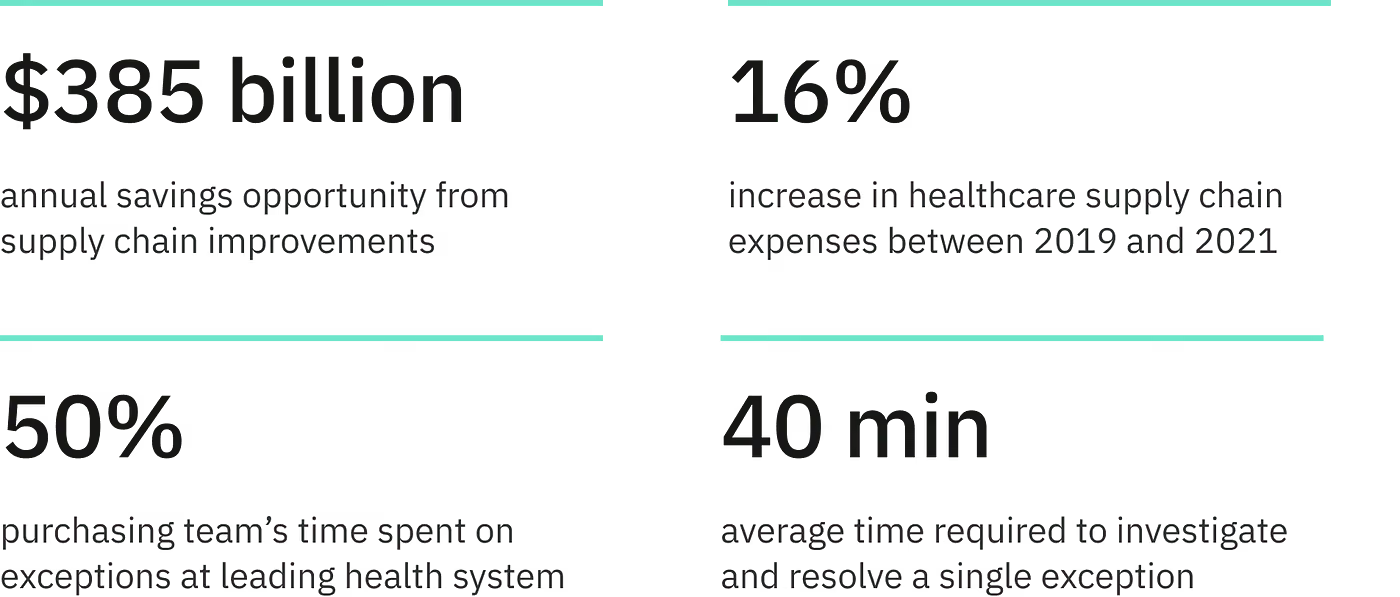
McKinsey has estimated an opportunity of $385 billion in annual savings from healthcare supply chain improvements. Supply chain expenses have jumped 16% between 2019 and 2021, increasing at a higher rate than labor or total expenses.
Where do match exceptions fit in?
A recent analysis found that an average of 10% of a health system’s spend/purchase order lines end up on the exception report. Once a voucher hits the match exception report, it invariably requires a human to look at it and investigate the root cause. On the provider side, this consumes upwards of 50%of the purchasing team’s bandwidth at a leading health system, and requires similar effort from Accounts Payable and Receiving, and even involvement from clinical teams. On the vendor side, it is estimated that a single exception takes an average of 40 minutes to investigate and bring to resolution. This, combined with increasing purchasing volumes, makes this a ballooning high-value problem.
What is the current state?
Most ERP systems have their own system of creating and resolving match exceptions. Oracle’s Peoplesoft (the second leading ERP at US hospitals, after Infor) has an exception report used by the purchasing team and a Matching Workbench that is utilized by the Accounts Payable group. When an invoice is entered into PeopleSoft, the system checks a list of (matching) conditions that the invoice (or voucher in PeopleSoft terminology) needs to fulfill before it can be matched and paid, establishing a three-way match between the invoice, purchase order and receipt if applicable. Each of these conditions is related to a match rule.
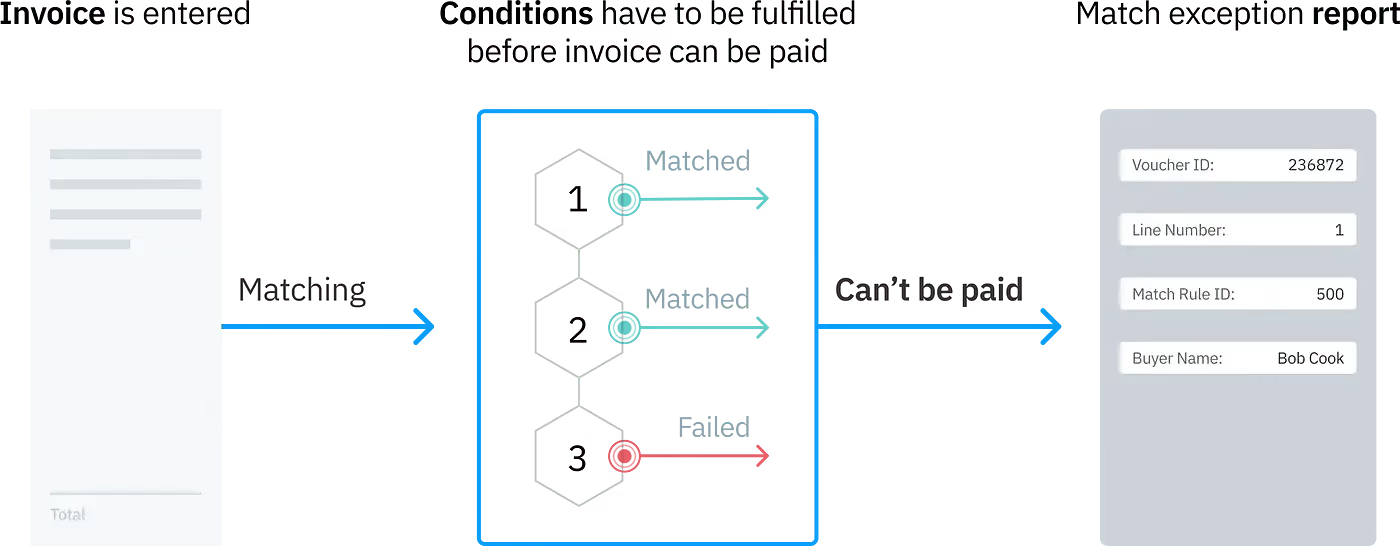
While the match rules that need to be met depend on a few purchase order characteristics, if even one of the required rules is not fulfilled, the system creates a match exception, which stops the invoice from being paid.
To maintain visibility of these exceptions, the purchasing team runs a recurring match exception report. This report provides a list of vouchers/invoices that failed to match and the rules they violate. Here is a sample of what that report looks like:
An average of 3,000 voucher lines translates to the report having well over 10,000 rows, making it a substantial undertaking for individual buyers to effectively manage and resolve.
Initial Solutions?
During my time at a leading health system, I worked with the various groups within the supply chain to understand what each of them needed to resolve match exceptions. I designed an Excel-based report that took the stock report generated by PeopleSoft ERP and rolled it up to the PO line level, making it more digestible by the team.
This turned the 14,000+ row stock report into a 1,200-row report — with one row per purchase order line. The tool would also assign these rows to different teams based on the match rules broken. This further reduced the number of exceptions the purchasing team had to manage and thereby increased their level of efficiency. We implemented additional enhancements to create a separate view for the contracting team, which rolled exceptions up to the item level and displayed the appropriate contract information. This allowed the contracting team to fix contract-related price exceptions at the item level by fostering more efficient communication with vendors to resolve instances where prices were not honored with respect to the negotiated contracts.
This tool continues to be used by the team today, two years after it was launched. Total match exceptions dropped 20% ($2.4 million based on the hospital’s annual spend) in the 6 months following its launch, which is a considerable decrease given the increasing rate at which exceptions continue to flow in. Receiving, accounts payable, and contracting teams expressed support, given that they only get assigned issues that they own, and are provided all the information they need to resolve them.
While this report represents a big step forward from the stock report, it still has drawbacks associated with being an Excel-based report. Since the report runs daily and a new file is generated every time, the team loses access to any notes they may have made to a previous file and need to maintain those locally. Any communication about an exception needs to occur via email or offline, and it is hard to collaborate with other team members when each person has their own copy/version of the report.
What can we do better?
Enter Exception Monitor: an integrated web application that serves as a workflow tool for healthcare supply chain teams to manage exceptions. It receives exceptions from the source ERP and maps it to other useful data such as item contracts, item master price, and price history, giving the team all the information they need to resolve an exception. They can make comments, assign exceptions to others, and track an exception from end to end.
While we are still enhancing the feature set based on user feedback, here are the highlights:
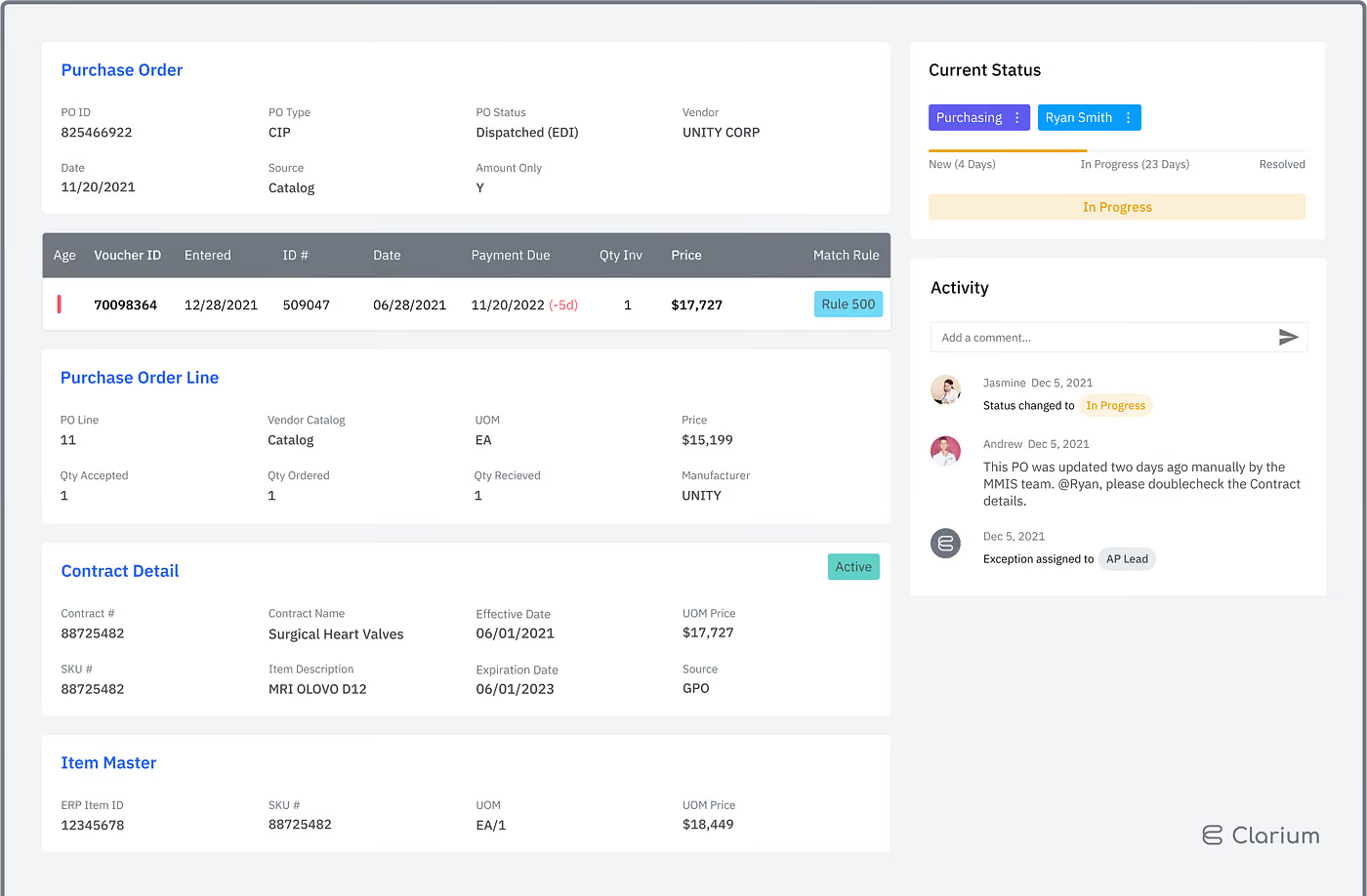
Analytics:
- Leaders can view statistics like the trend of exceptions created and resolved over a period of time, broken down by their teams, vendors, and root causes among other filters. This will allow them to define and track their key performance indicators (KPIs) and spot and address outlier issues before they snowball.
- Team members can view summary statistics related to their own exception queues and keep track of their progress, and work with their leaders to define shared goals and their corresponding metrics
Intelligent Four-Way Matching:
- Our intelligent algorithms identify the most appropriate contract for each given purchase order line item, in addition to the traditional three-way matching of the invoice to the purchase order and receipt. Team members can use this information to readily root-cause the exception and quickly proceed to resolution.
Prioritization:
- Leaders can define exception prioritization rules, by assigning weights (importance) to characteristics such as due dates, payment terms, and statistics like the percentage of total spend on exception by vendor. An advanced model would use this to rank individual exceptions in their respective queues.
Auto-Assignment & Collaboration:
- An advanced model would categorize and assign individual exceptions to the appropriate team/team members using exception characteristics, historical data, and user feedback. The model would suggest actions-to-resolution
- Individual team members would see all the information they need to resolve an exception on one screen, along with suggested actions. They can collaborate with other teams (and their members) with ease using comments. The tool notifies team members when someone re-assigns an exception to them, or tags (@mentions) them in a comment.
The goal of this product is to enable the supply chain team to resolve exceptions in the most efficient way possible, by minimizing the time they would spend performing non-value-add activities such as looking through their locally stored notes, copy-pasting exception information into emails, or searching for item contract information in multiple contract databases.
We want to create a seamless experience for the team, wherein they log in, know exactly what they need to do based on the priorities, and have all the information at their disposal to swiftly work toward resolution and track progress along the way. This translates to direct labor savings through increasing workforce efficiency, capital gains through prioritizing payment discounts, and reduced supply impact by minimizing and swiftly resolving credit hold situations. It is also a scalable, robust, and flexible long-term solution that increases supply-chain resilience.
Key Learnings and Way Forward?
Match exceptions are the symptom of a bigger problem. While Exception Monitor helps increase the outflow of exceptions (so we can live to fight another day), health systems need to also reduce the inflow. But what is the root cause of these exceptions that are flooding our purchasing teams?
- Item Master Data Integrity: Given the significant percentage of spend associated with our item master items, maintaining our item master data integrity is paramount to reducing the inflow of exceptions. We need to ensure our item master stays up to date with our contract prices and their effective dates. This is especially challenging with the multitude of price sources, ranging from Group Purchasing Organization (GPO) contracts, regional tiers and contracts, local agreements, and so on.
- Contract Price Management: We have multiple sources of contract pricing and multiple places where our pricing lives; our item master, vendor catalogs, and vendor-managed ‘punchout’ sites. Making sure each of these is up to date with our latest contract price is an increasingly complex challenge.
- Vendor Contract Exceptions: We have seen lags in price effective dates between provider and vendor systems contributing to exceptions in that intersectional period. This is the time between when you activate a contract with your GPO, and load that pricing in your ERP, and when the vendor loads that contract pricing to your account in their system. If any items on that contract are ordered in the interim, the POs will reflect the correct contract price while the vendor’s invoices will not. And while they will eventually honor the contract price, this will require manual intervention which is less than ideal.
- Systemic Limitations: A single healthcare system has purchasing relationships with hundreds of vendors. They each have their own purchasing and invoicing systems, with their own customizations and policies. These systems communicate with each other using paper (print), fax, and more recently email and EDI (Electronic Data Interchange). The individual limitations of the source system, combined with the limitations of the dispatch method used lead to a multitude of issues such as misapplied lines, invoicing before or without shipping, inability to process quotes, comments, change-orders, refunds, credits, or other non-standard fields, or incorrectly processing them, and the list goes on.
Each of these areas is ripe for innovation and requires partnership across the provider-supplier spectrum to effectively resolve. We look forward to collaborating with leaders on both ends of this spectrum to build modern, robust, and resilient solutions to these problems.

How Clarium is Helping Hospitals Navigate the Supply Chain Impact of Hurricane Helene
In the wake of Hurricane Helene’s devastating impact on the southeastern United States, healthcare systems across the country faced a critical challenge: a major disruption in their supply chain for essential IV solutions and other vital medical products. As the storm forced the closure of a key Baxter manufacturing plant, health systems scrambled to understand the scope of the impact and develop mitigation strategies. In this time of crisis, Clarium’s AI-powered supply chain resiliency platform proved to be an invaluable asset, enabling our customers to rapidly assess the situation and take proactive measures to ensure continuity of care.
Proactive Response to an Unforeseen Crisis
When news of the Baxter plant closure broke, the Clarium team sprang into action. We quickly procured the list of affected items from industry organizations like AHRMM and our health system clients. Leveraging our platform’s custom tag feature, we created a “Baxter Helene Impact — 2024” tag and applied it to all affected items across our customer base.
This swift action allows our customers to:
- Easily filter and identify which of their used items are affected by the Baxter plant closure
- Triage the impact using comprehensive data available in the Clarium platform, including:
- Current burn rates
- Stock levels
- Days on hand
- Distributor stock levels and days on hand
- Approved substitutes within the Clarium network
Increased Visibility and Resilience
The Clarium platform’s Disruption Monitor module, already a cornerstone for many leading health systems in managing supply disruptions, proved especially crucial during this event. By integrating the hurricane impact data with our existing wealth of information, we provided our customers with:
- Real-time disruption signals
- Intelligent insights and warnings
- The ability to be proactive in procuring products or substitutes before stockouts occurred
This comprehensive view is giving Clarium customers a significant edge in maintaining supply continuity and, most importantly, ensuring uninterrupted patient care.
Efficiency in Action
Our Substitute and Task Manager tools further enhance our customers’ ability to respond efficiently to the crisis. Health systems can:
- Derive mitigation strategies based on internally approved substitutes, or recommendations from the Clarium provider and supplier network.
- Create and manage tasks related to sourcing alternatives or implementing conservation strategies
One of the most striking demonstrations of Clarium’s value during this crisis is our robust substitute management capability. Our analysis revealed that 74% of unique items affected by the Hurricane Helene disruption have a clinically approved substitute available within the Clarium network. When considering each item uniquely within a client, that number rose to 87%.
These statistics highlight the critical role that Clarium’s extensive network and substitute management features play in mitigating supply chain disruptions. By providing instant access to a vast array of approved alternatives, we enable our clients to quickly pivot and maintain essential supplies, even in the face of significant manufacturing disruptions.
René Gurdián, AVP, Supply Chain Finance and Strategy at Ochsner Health, shared their experience:
“When Hurricane Helene hit, we were facing a potential nightmare scenario with our IV solution supply. Clarium’s rapid response and comprehensive data integration allowed us to get ahead of the problem. We have a clearer picture of our exposure, available alternatives, and a roadmap for maintaining critical supplies while also learning where data discrepancies occur and how we improve our utilization of the Clarium platform. Their platform’s ability to provide actionable insights immediately with unified data from providers and suppliers is truly a game-changer for us.”
Continuing Support
As the situation continues to evolve, Clarium remains committed to providing our customers with up-to-the-minute information and support. Our platform continues to receive and process real-time disruption signals, ensuring that health systems have the most current data at their fingertips to make informed decisions.
The response to Hurricane Helene demonstrates the power of Clarium’s AI-driven approach to healthcare supply chain management. By combining comprehensive data integration, intelligent analytics, and a proactive stance, we’re helping healthcare systems not just respond to crises, but build long-term resilience in an increasingly complex and unpredictable world.
At Clarium, we’re proud to stand alongside our customers as they navigate challenges and continue to deliver exceptional patient care. Together, we’re building a more resilient, efficient, and responsive healthcare supply chain for the future.
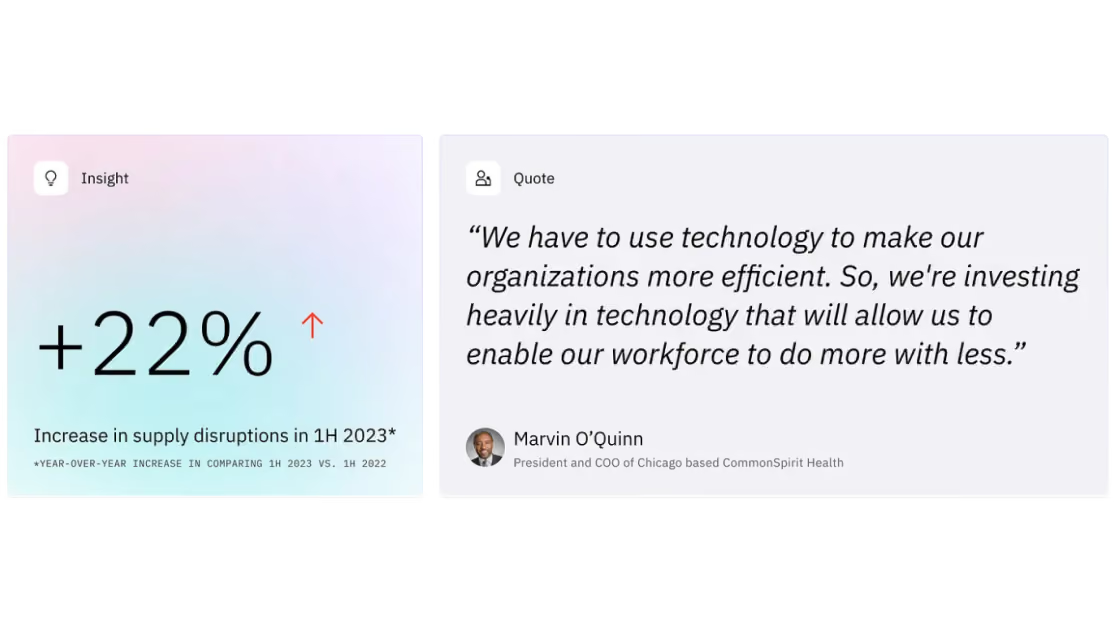
Next-Gen Healthcare Supply Chain: Unleashing AI and Machine Learning for Resiliency and Efficiency
In the fast-paced world of healthcare, the seamless availability of vital supplies is paramount to delivering exceptional patient care. However, hospitals often grapple with the challenges posed by supply disruptions, which can lead to wasted time, financial strain, and compromised patient outcomes. In this blog post, we discuss a software solution that empowers hospitals to proactively detect and manage supply disruptions, increasing resiliency and efficiency in their operations and fostering better patient care.
Supply chain disruptions were up 22% in the first half of 2023, as compared to the same period in 2022. 99% of respondents in a healthcare executive surveycited challenges in supply procurement, including shortages of key items and significant price increases. More than 2 years later, we are still faced with unpredictability and associated risk in our supply chains.
Marvin O’Quinn, President and COO of Chicago based CommonSpirit Health cited investing in technology as a sustainable long-term strategy to addressing current economic headwinds. “We have to use technology to make our organizations more efficient . . . so, we’re investing heavily in technology that will allow us to enable our workforce to do more with less.”, he said in a recent interview with Becker’s Health.
Enter the era of cutting-edge software technology designed specifically for healthcare supply management. We built an innovative software platform that acts as a powerful ally, enabling hospitals to navigate the intricate web of supply chains with efficiency and agility. By harnessing advanced algorithms and real-time data analysis, Disruption Monitor empowers healthcare providers to anticipate, address, and mitigate potential disruptions before they impact patient care.
At the heart of this software lies its ability to detect supply disruptions in advance. By monitoring various factors such as market trends, supplier performance, and global events, hospitals can gain crucial insights into potential disruptions. Armed with this information, healthcare organizations can take proactive measures to secure alternative supply sources, reducing the risk of shortages and maintaining uninterrupted patient care.
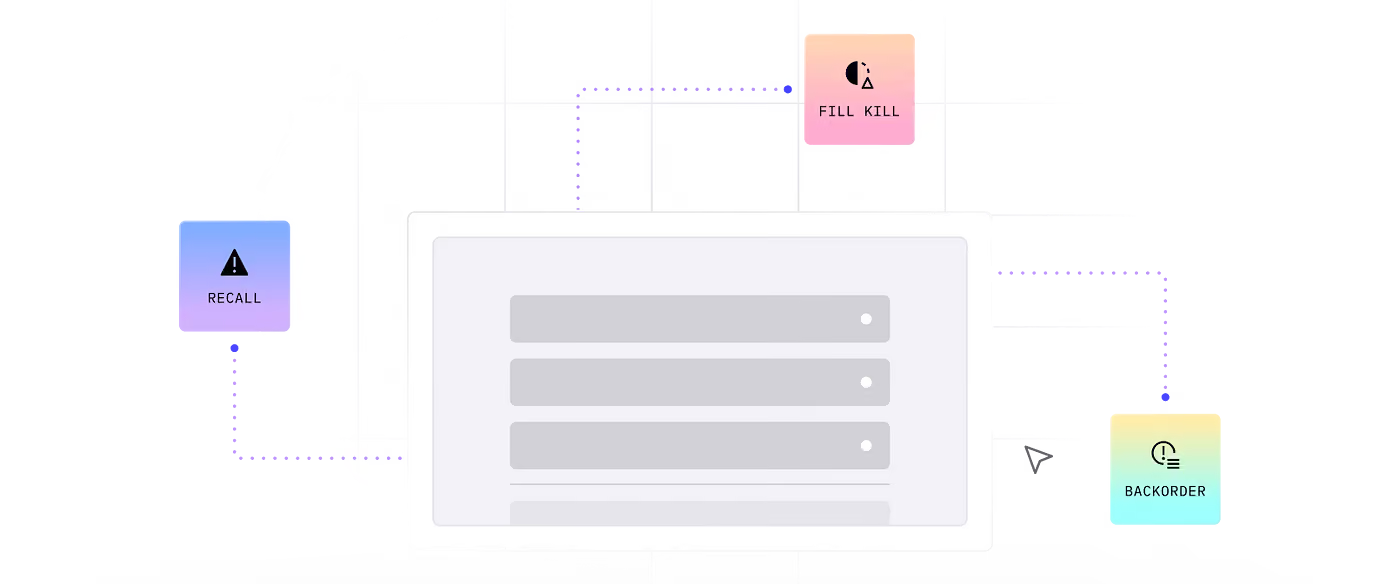
One of the standout features of this software is its unique crowdsourcing capability. Through a growing network of participating providers, hospitals can tap into a shared repository of substitute supplies. In the face of a disruption, this feature enables healthcare organizations to reach into the collective knowledge of all providers within the network, sourcing vital resources that would otherwise be unavailable. This collaborative approach not only saves time and money but also fosters a sense of solidarity within the healthcare community, ensuring patients receive the care they deserve.

The impact of this software on hospital operations and patient care is truly transformative. By streamlining supply management processes and reducing the time spent on reactive problem-solving, hospitals can optimize their workflows and allocate resources more efficiently. This not only translates into cost savings but also frees up valuable time for healthcare professionals to focus on delivering superior patient care, ultimately enhancing patient outcomes and satisfaction.
Moreover, the tool’s comprehensive data analytics capabilities offer hospitals invaluable insights into supply utilization patterns, enabling them to make data-driven decisions regarding procurement, inventory management, and resource allocation. With comprehensive visbility of their supply needs and usage trends, healthcare organizations can optimize their supply chains, reduce waste, and identify areas for improvement.

Closing thoughts
The advent of advanced software solutions tailored to healthcare supply management marks a significant milestone in the industry. By proactively detecting and managing supply disruptions, hospitals can save time, reduce costs, and deliver better patient care. The ability to crowdsource substitutes from other providers within the software provider’s network adds an extra layer of resilience, fostering collaboration and ensuring uninterrupted access to critical supplies. As the healthcare landscape continues to evolve, harnessing the power of technology will undoubtedly shape a brighter future for healthcare organizations, professionals, and the patients they serve.

How we doubled productivity for a leading hospital supply chain team
In our last post, we introduced “Exception Monitor”: a workflow automation tool that enables healthcare supply chain teams to effectively manage their invoice/match exceptions. We built and launched this tool with our pilot partner in May 2022 and have continued to add features and enhancements. In this article, we share the key wins, learnings, and opportunities that we have uncovered during our ongoing pilot with a leading hospital.
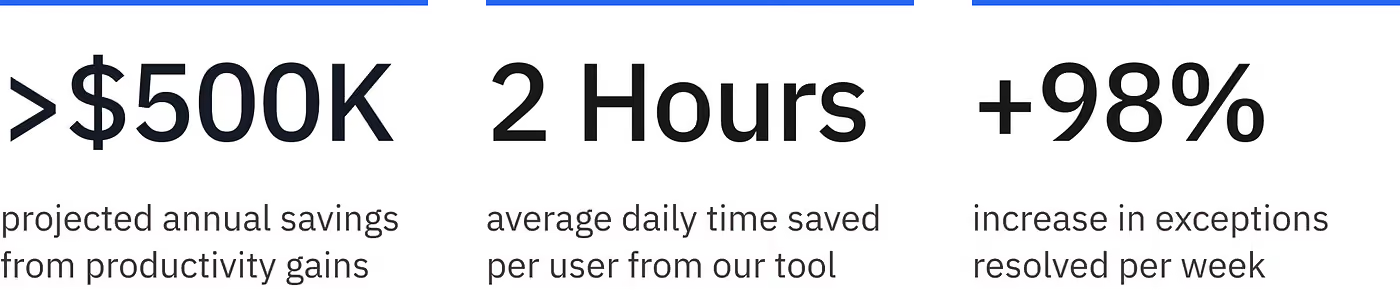
Key Wins
Exception Resolution Rate Increased by +98%
One key performance indicator (KPI) we use to track the success of “Exception Monitor” is the percentage increase in our client’s exception resolution rates. We tracked their average resolution rate over the 6-week period preceding our launch and have compared it to the period since. Prior to launch, our client was resolving 340 exceptions per week. Since launch, they have been resolving 675 exceptions per every week. Given that their team is spending the same amount of time on managing exceptions, this statistic represents a doubling of their productivity.
$500,000+ in Projected Annual Savings
Prior to the launch of Exception Monitor, our partner hospital’s purchasing team spent approximately 50% of their time managing exceptions. With our tool doubling productivity, these team members get back 2 hours each day. As a result, the impact from employee time savings alone is worth over $175,000 annually for a team of 8. Adding in the time savings for the additional departments now using our tool (including Contracting, Accounts Payable, Receiving, and Systems), we estimate over $500,000 in projected annual savings — just for employee time.
80% of Our Active Users Log In Every Week
We have a highly-engaged user base that sees the value that this tool brings them as 80% of them log in every week. Our users influence our product roadmap by continuing to request and prioritize features that bring them the highest operational value. In total, our users spend over 82 hours in our tool every week, with each individual user spending an average of 61 minutes in the tool daily.
Overall, these key metrics directly translate to reducing supply disruptions by accelerating the resolution of exceptions, reducing the accounts payable outstanding to suppliers, avoiding credit holds — giving invaluable time back to supply chain teams to focus on higher priority initiatives.
New Features
Analytics Dashboard
Hospital executives and supply chain teams can use our new dashboard to visualize and monitor the KPIs they track for match exceptions across their organization. We worked with them to create metrics that track historical trends, as well as give a current snapshot of pending exceptions. They are now able to track performance metrics that they did not previously have access to, such as first contact SLAs and queue time. This gives them insight into process bottlenecks, enabling them to prioritize resources effectively and track progress over time. Users can filter this dashboard by team, user, and vendor.
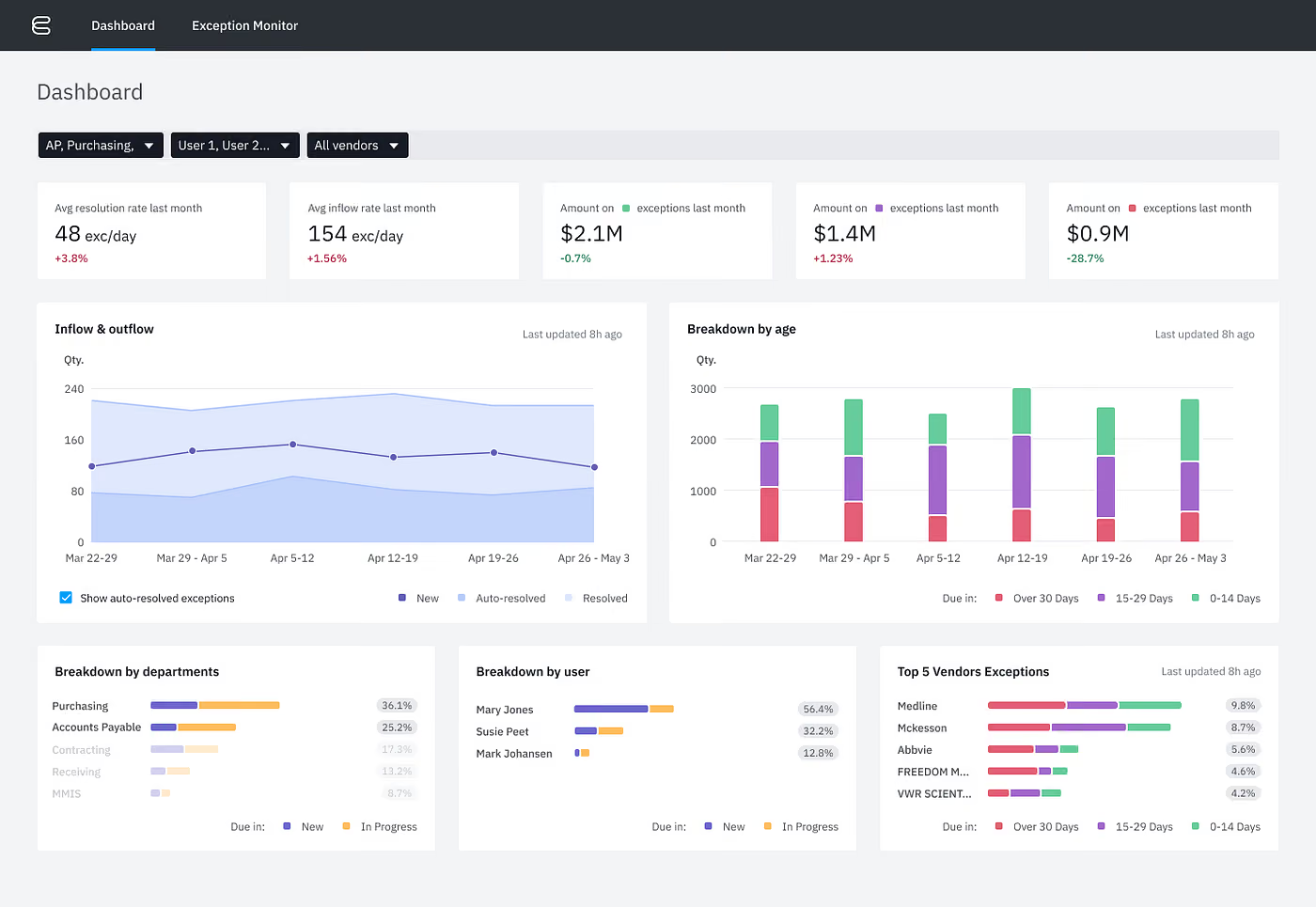
Bulk Actions
One of the things we learned is that while some teams work on exceptions as a single entity (working on one individual exception at a time), others work on them by grouping related exceptions together by contract, vendor, and purchase order. This led us to create the bulk actions feature, which allows users to take actions on multiple exceptions with one click in our tool. Bulk actions include: changing exception status, adding a comment, re-assigning exceptions, and exporting exceptions to a CSV file. Bulk actions allow each team to work at the level of granularity they find most efficient and productive.
Customized Views
Another key learning is that each team focuses on different data points while working their exception queues. For example, while the pricing/contracting team directs their attention primarily toward price differences (between the purchase order, invoice, and contract), the receiving team only looks at the quantity variance (between the purchase order, invoice, and receipt). To address these differences, we created a custom column filter — allowing individual users to select the columns they want to view in their queue. This helps teams eliminate the noise and focus on the data that truly matters to them, allowing them to resolve exceptions faster.
Root Cause Identification
Supply chain teams have been resolving match exceptions ever since ERP systems were first adopted. Efforts to reduce the inflow of exceptions at the source lacked one key piece of information: a historic record of root causes. You can only ever see a snapshot of exceptions at any given time. Each team member will tell you what the most common root cause is, but there is no system to record this information and view it at scale across multiple teams.
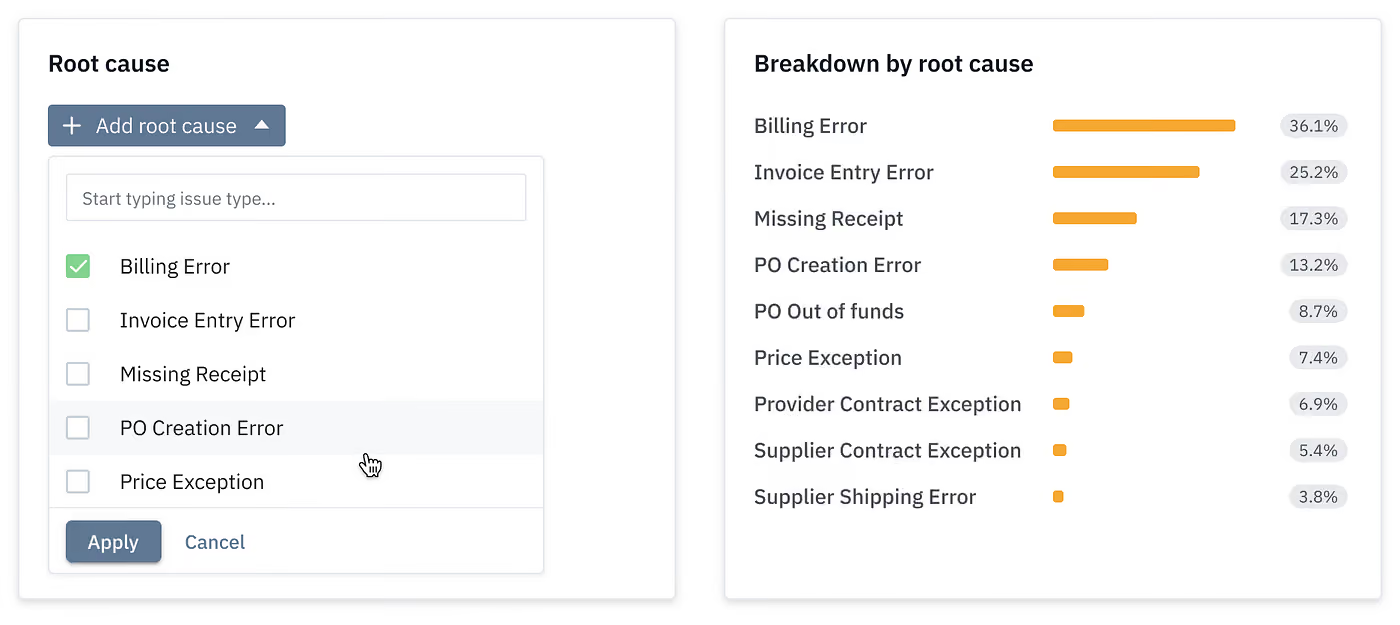
We address this problem by allowing users to identify the root cause(s) at the source, when working on an exception. Leaders can view reporting on root-causes on their dashboard — for the entire organization or broken down by team, user, or vendor. This allows leaders to focus on resolving the largest root causes at the source and work with vendors to resolve recurring issues. Not only does this feature help teams resolve exceptions faster, it also reduces the number of exceptions created in the first place.
What’s Next?
AI-Enabled Monitoring
“Exception Monitor” does a phenomenal job at helping the healthcare supply chain teams resolve their exceptions efficiently. What if we could help prevent exceptions from arising in the first place? We plan to use our AI-enabled algorithms to surface real-time alerts and identify patterns such as:
a) SKU #123 recently had a price change, and 3 associated POs have been on exception since.
b) Contract S1000 is in effect, but your item master has not been updated yet resulting in 5 exceptions so far.
c) You have not received any product from Supplier X in the past 15 days, and all of their POs are on receiving exception.
Our proactive alerts will help the teams resolve issues at the source before they snowball and even prevent exceptions for occurring in the first place.
Two-Sided Network with Suppliers
Healthcare suppliers have expressed significant interest in using this same tool to enable data transparency and helping resolving these exceptions in real-time. We will be launching “Exception Monitor” with suppliers to allow them to view their specific client’s match exceptions and interact with them directly within our tool. This creates enormous efficiencies by removing the need for health systems to export relevant exceptions, email them to suppliers, and communicate via phone.
With this functionality, suppliers will be able to interact with providers directly within the tool, and attach documents such as credit invoices and proof of delivery that will go directly to the relevant team and user. Ultimately, this enables suppliers to be paid faster and allows hospitals to benefit from favorable payment terms — creating a true win-win relationship.
Key Takeaways
Healthcare supply chains are ripe for automation. We have proven through “Exception Monitor” that data-enabled automation has led to an astounding increase in efficiency and productivity in resolving match exceptions. However, this process is only one of the many workflows that healthcare teams perform daily.
Today, hospitals have existing processes and workflows that are highly manual and inefficient to deal with a variety of daily tasks such as: demand planning for surgical cases, managing and approving substitutes, identifying and resolving backorders, tracking recalls, analyzing contracts for upcoming renewals, and many more. While some health systems have created stop-gap solutions to help with these using homegrown tools like SharePoint and Power BI, most are still overwhelmingly relying on email and Excel.
There remains a huge opportunity for supply chain automation — to build software that not only automates all the redundant, repetitive, and data-querying tasks, but also leverages AI to analyze historical data, identify patterns, and proactively recommend actions. Clarium is continuing to build game-changing software tools like these with our pilot hospitals, and we couldn’t be more excited for what’s to come.