---
title: "Health system CFOs to supply chain: 'Show me the money'"
description: Eric O'Daffer reveals how empowering supply chain executives and investing in AI can drive substantial cost savings for health system CFOs. Collaboration between CFOs and supply chain leaders can optimize costs and enhance clinical care.
image: https://www.clariumhealth.com/hubfs/EOD%20-%20Advisor%20Spotlight.png
---
Blogs
# Health system CFOs to supply chain: 'Show me the money'
[ Eric O'Daffer ](https://www.clariumhealth.com/newsroom/author/eric-odaffer)
Jul 1, 2026
[Blogs](https://www.clariumhealth.com/newsroom/tag/blogs)
Health system CFOs to supply chain: 'Show me the money'
5:10
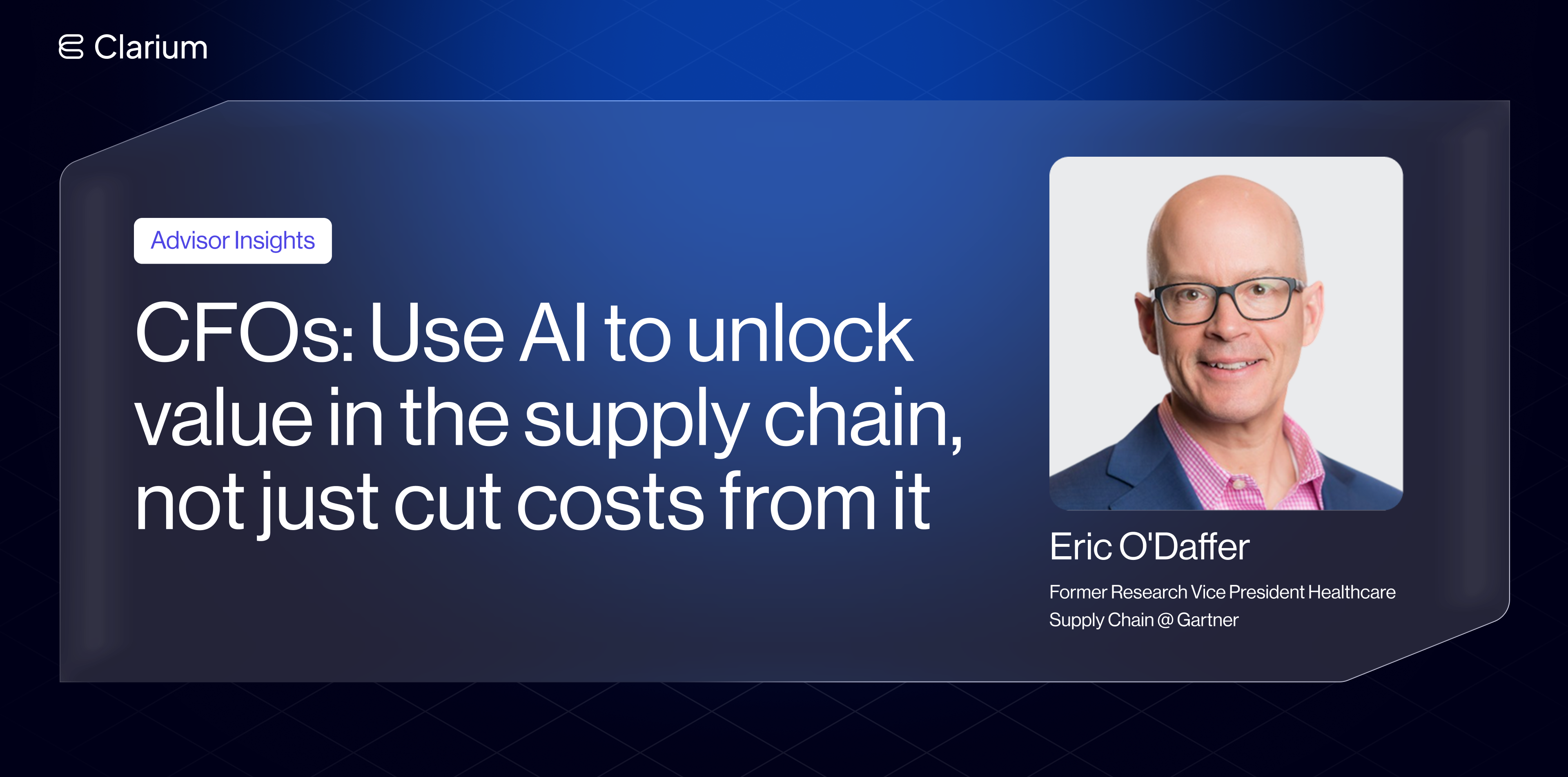
*Clarium Strategic Advisor, Eric O'Daffer, recently posted a blog, "*[*Healthcare CFO: Show me the Money!”*](https://www.linkedin.com/pulse/health-system-cfos-show-me-money-eric-o-daffer-bcnvc)*, about the value that supply chain can bring for health system chief financial officers looking for cost savings. At a time when supply chain executives at health systems are facing unprecedented headwinds, O’Daffer argues that CFOs would be wise to empower these leaders and invest in AI to manage spend. *
*Here’s an excerpt: *
As implied in the classic demand “Show me the money!” in the film Jerry Maguire, there is a massive financial opportunity to demonstrate value waiting inside your organization. I encourage you — the health system CFO — to engage with your supply chain leadership team in a deeper strategic alliance to drive these results. Your team possesses the technical know-how to deliver savings, but they need your passionate leadership, backing, and a willingness to give them the strategic support required to get the job done.
Being a CFO of a health system is an incredibly demanding job. Balancing shifting reimbursement models, uncompensated care, and the iary pressures of keeping a low-margin, vital caregiving engine humming is a monumental task. Currently, nearly 60% of CFOs have supply chain reporting directly to them, which gives their supply chain teams a unique opportunity to align with the CFO’s vision now more than ever. However, it is vital to look closely at a recent trend: health systems are reducing supply chain title, scope, and compensation while making leadership transitions without a seamless succession plan. My insights here are intended to provide a candid look at the market gained from talking with 75 chief supply chain officers (CSCOs) at large, leading health systems over the past 12 months. I come with collaborative solutions, not just an analysis of the challenges.
Supply chain leadership is facing unprecedented headwinds at a growing number of health systems in the U.S. With roles being restructured, positions being shifted down the org chart, and capital investments being paused, many health systems are inadvertently losing momentum at the exact moment they should be accelerating supply chain support to drive financial returns. This is especially true in the area of indirect spend management/purchased services where trusted relationships, governance, and continuity are most important for enacting change and delivering value.
Chief supply chain officer roles that once reported to the C-suite are being shifted to VP roles reporting downline. This can inadvertently result in a fractured hiring strategy, gaps in development, and a lack of long-term succession planning. Furthermore, there is a wide disparity in compensation across the country, with some systems investing over a million dollars for top-tier enterprise roles while others budget a quarter of that for similar responsibilities.
**Over 40% of the 75 leaders of large, mature healthcare provider supply chains I’ve talked to in the past year have been in their roles for less than three years; nearly 25% have been there for less than one year.** It is incredibly difficult to reach that stable cruising altitude when health systems are forced to frequently change pilots.
When organizations downsize supply chain leadership roles, it suggests the supply chain is still being viewed through the legacy lens as a "product availability" or “contract price negotiation” function, rather than as a powerful strategic lever for cost optimization and enabling improved clinical care.
Fortunately, this isn't happening everywhere. I see highly encouraging progress in specific pockets, but this concerning trend is creating a widening chasm between the systems that proactively invest in supply chain excellence and those that defer it.
**AI can provide value**
CFOs, you need to commit to the strategic function that impacts 40% of your operating cost. Move beyond the traditional "VP of procurement" mindset and elevate or maintain a dedicated CSCO role. **According to the Health Management Academy, supply chain is currently ranked 10th out of 15 categories for CFO investment priorities in 2026. **Elevating its priority on your list allows you to invest in the specialized talent and technology required to drive transformational service improvements.
When it comes to AI, healthcare supply chain has historically taken a cautious, "prove it to me" approach to new technology. However, while healthcare waits, a massive wave of innovation and investment is flowing into AI-driven supply chain solutions in other sectors.
For CFOs and supply chain leaders, I encourage you to get off the sidelines and actively explore how partnering with AI platform innovators can support your fiscal goals both in managing supplier spend and in reducing your total cost of supply chain staff by augmenting with AI workforce solutions.
*This text has been condensed and repurposed for Clarium by Gabe Perna. *
### Similar posts
Press
#### [Clarium Raises $27M Series A to Scale AI-Powered Supply Chain Resiliency Technology to Leading Health Systems](https://www.clariumhealth.com/newsroom/clarium-raises-27m-series-a-to-scale-ai-powered-supply-chain-resiliency-technology-to-leading-health-systems)
Amid global supply chain volatility, Yale, Stanford, and Kaiser Permanente build resilient healthcare supply networks powered by Clarium .
Clarium Health May 8, 2025
Blogs
#### [Next-Gen Healthcare Supply Chain: Unleashing AI and Machine Learning for Resiliency and Efficiency](https://www.clariumhealth.com/newsroom/next-gen-healthcare-supply-chain-unleashing-ai-and-machine-learning-for-resiliency-and-efficiency)
Discover how Clarium Health's innovative software leverages AI to enhance healthcare supply chain resiliency and efficiency, ensuring better patient...
Reuben Philip Jul 18, 2023
Blogs
#### [Leveraging Intelligent Automation in Healthcare Supply Chain](https://www.clariumhealth.com/newsroom/leveraging-intelligent-automation-in-healthcare-supply-chain)
Discover how intelligent automation can revolutionize healthcare supply chain management, reducing costs, inefficiencies, and improving patient care...
Reuben Philip Apr 22, 2025
```json
{
"@context" : "https://schema.org",
"@type" : "BlogPosting",
"author" : {
"@type" : "Person",
"name" : "Eric O'Daffer",
"url" : "https://www.clariumhealth.com/newsroom/author/eric-odaffer"
},
"dateModified" : "2026-07-01T15:01:53.352Z",
"datePublished" : "2026-07-01T15:01:53.000Z",
"headline" : "Health system CFOs to supply chain: 'Show me the money'",
"image" : [ "https://www.clariumhealth.com/hubfs/EOD%20-%20Advisor%20Spotlight.png" ],
"mainEntityOfPage" : {
"@id" : "https://www.clariumhealth.com/newsroom/cfos-supply-chain-leaders-can-show-you-the-money",
"@type" : "WebPage"
},
"publisher" : {
"@type" : "Organization",
"logo" : {
"@type" : "ImageObject",
"url" : "https://www.clariumhealth.com/hubfs/Full%20Black-1.png"
},
"name" : "Clarium"
}
}
```